I love murals and street art. If you like murals or have a mural you'd like to post, this meme is for you. Just follow the Linky steps below. Once you start looking you will find murals everywhere. The "Monday Mural" meme goes live on Monday at 12,01AM, Perth,Western Australian time. Be sure to link back to this blog and visit your fellow posters. Looking forward to your mural finds this week.
Thanks Sami
Mural seen at the Stockland Bullcreek shopping centre of two white-faced herons, painted in March 2023 by Kerise Delcoure.
I have previously showed the huge murals she painted at the same shopping centre in a post in 2019 and again in 2021. This is a small mural compared to the others, but very pretty as well.
I love murals and street art. If you like murals or have a mural you'd like to post, this meme is for you. Just follow the Linky steps below. Once you start looking you will find murals everywhere. The "Monday Mural" meme goes live on Monday at 12,01AM, Perth,Western Australian time. Be sure to link back to this blog and visit your fellow posters. Looking forward to your mural finds this week.
Thanks Sami
Painted in October 2020 by Perth artist Paul Deej at the Port Kennedy skate park in one of Perth's southern suburbs.
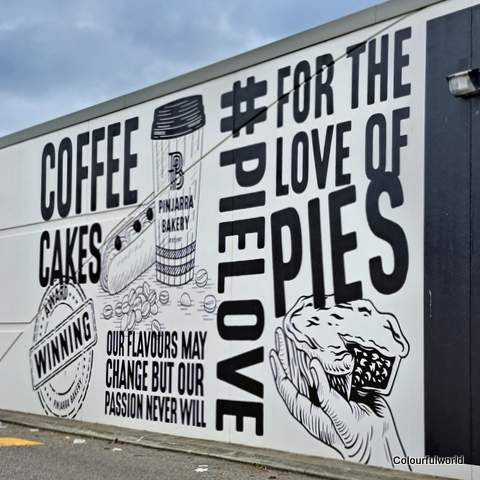
On the walls of the (Perth) famous Pinjarra bakery, known for their award winning pies.
Also taking part in the Signs meme. For other signs from around the world check Tom's blog.
Friday 1st - I joined bloggers Iris (visiting from Germany) and Grace at the Cottesloe Beach, for Sculpture by the Sea, a free to the public sculpture exhibition which is held at Cottesloe Beach. This was their 20th year, and it opened on the 1st and ran until the 18th March.
After walking around, we enjoyed an ice-cream. Later I drove Iris to Fremantle, then drove to the northern suburb of Mount Lawley to meet up with a "new friend" visiting from Portugal. Dulce, an 80 something stylish lady, was visiting her granddaughter for 2 months, and the latter had asked on a "Portuguese in Perth" website if anyone was keen to meet up with the granny and also lend her Portuguese books to read. I volunteered for both, so this was our first meeting, where I took her out to coffee.
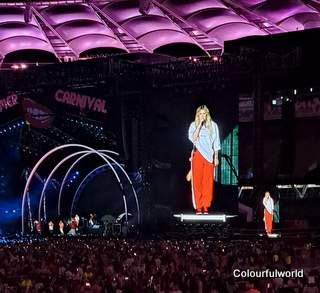
Saturday 2nd - My birthday. In the morning I prepared some of the goodies for my birthday party which I was hosting the following day. In the afternoon Jose and I took a train to Optus Stadium to attend Pink's concert.
Pink played on Friday and Saturday with an attendance of about 60 thousand people at each concert!
The atmosphere at the stadium was amazing, more than half the crowd was wearing pink, singing along, dancing....
Before she came on, there was a DJ, then the Australian singer Tones and I, well known for her record-breaking song "Dance Monkey".
Tones and I
Tones and I - Dance Monkey
Pink all over :)
The highlight of the concert was when Pink and daughter Willow sang "Cover me in Sunshine".
Cover me in Sunshine - Pink and Wllow
These clever signs at the Stadium were really fun as they used titles of Pink's songs to transmit important messages.
Sunday 3rd - For my birthday celebration, we had 24 people for lunch in our patio. Some friends brought goodies to add to our table as well.
When we get to a certain age, we have everything we need and don't need any gifts, but I was showered with wonderful gifts from my friends.
Iris hand painted me a precious birthday card with balloons (which you can see around the bottle on left)
Iris and I (Grace didn't want to appear on photos)
Saturday 9th- I attended a "Less Waste Workshop" at the local Canning River Eco Education Centre (Creek) from 10am to 12pm.
At 3,30 I was in the city centre for a meeting with ladies from the Portuguese Womens's Association to discuss our Carnival dinner event we held in February and to talk about our next event on the 1st of June.
When the meeting finished I picked up two friends in Mt Lawley (one of them the lady I had met the week before), drove home, changed, and when Jose got home from having worked that weekend, we went to the Women's Day dinner at the Portuguese club in Fremantle.
Idalia, Vina and the new friend Dulce with me behind them
Friday 15th - a quick check up at the dentist to make sure all was well with the bone graft for my dentist to do the implant soon. All ok.
Because it was at the other dental office in another suburb, on the way home I stopped to take photos of murals around the Canning River area.
Wednesday 20th - took the train to Subiaco to have dinner with a friend visiting from Brasil. We first maybe a decade ago via our blogs when Monica lived in Perth.
Monica and I had dinner at Delisio Italian restaurant
Friday 22nd - Joined by our friends L & W, we departed to Hamelin Bay for a 4 day camping trip.
No net or phone reception, so it was quiet, but the 4 of us spent a lot of time talking, we went to the beach a couple of times to see the stingrays, which were amazing.
The birds were friendly :)
Hamelin Bay Beach
Stingrays coming close to shore.
Stingrays video
Monday 25th - We packed up in the morning and left the camp at about 10,30. First stop in Margaret River for a coffee, then we stopped at Myalup to fill up with petrol and to have a sandwich for lunch.
Jose had been suffering from back pain for a few days before we left, and will all the picking and moving, etc he was in pain when driving back, so en-route I arranged a physio appointment, and he just made it, as we arrived home at 3,50 and the appointment was at 4pm.
Tuesday 26th - I had the day off and picked with Dulce (my new friend, who would be leaving Perth the following week) and took her to Pinnaroo Valley Memorial Park, a different type of cemetery in the suburbs, with beautiful green areas, statues, birds and kangaroos.
After walking around the park and taking photos with the kangaroos we drove 10 minutes to Hillary's Boat harbour for a fish and chips lunch.
Beware chip thieves operate here
This big bird was being assembled at Hillary's. Not sure if it is for a special event.
Sunday 31st - Jose and I went to see a French movie - "Iris and the Men" - one of the films from the 35th season of the Alliance FrancaiseFrench Film Festival. I like the actress Laure Calamy, which I first saw in the very funny French series "Call my Agent" on Netflix.
I love murals and street art. If you like murals or have a mural you'd like to post, this meme is for you. Just follow the Linky steps below. Once you start looking you will find murals everywhere. The "Monday Mural" meme goes live on Monday at 12,01AM, Perth,Western Australian time. Be sure to link back to this blog and visit your fellow posters. Looking forward to your mural finds this week.
Thanks Sami
Murals in the inner city suburb of Subiaco (or Subi).
Sky's Chorus - on a laneway next to 30 Rokeby Road, panted in 2012 by Perth artist Clare McFarlane. It captures a flock of migrating Carnaby Black Cockatoos, against the colours of the Australian desert landscape.
Another mural painted in 2012, of a black swan by another Perth artist - Robert Jenkins, in his trademark leaf pattern.
Here are 3 other murals from this artist that I've posted in my blog:
I love murals and street art. If you like murals or have a mural you'd like to post, this meme is for you. Just follow the Linky steps below. Once you start looking you will find murals everywhere. The "Monday Mural" meme goes live on Monday at 12,01AM, Perth,Western Australian time. Be sure to link back to this blog and visit your fellow posters. Looking forward to your mural finds this week.
Thanks Sami
Hope you all had a wonderful Easter. We are still enjoying the Monday public holiday.
From our trip to the coastal town of Cervantes in October 2023.On our return to Perth we stopped in Lancelin to have lunch in the pub, and I found this Angel wings mural on the boundary wall of a house that faced the beach at Harold Park (Gingin Road).
These 6 x 3mt wings were painted in 6 hours by Lindsay, a talented Perth artist in May 2020. (I haven't been able to find out more about this elusive Lindsay).
I was even wearing a matching T-shirt :)
This gigantic chair at the entrance to Lancelin, had the words "Caring 4 kids" on the back of the chair.


.jpg)

.jpg)
.jpg)
.jpg)
.jpg)