When we left the Porto apartment we had for the first day, we drove to our next Airbnb apartment just to familiarise ourselves with where it was - it was only about 700mt away, how great!
It was 11AM and we could only check-in at 2PM, but our car was full of visible luggage, so we parked it in a parking garage next to the Court House with the boot facing the wall so it was safe, and we were then free to start walking around.
 |
| Court House and statue called Justice , done in 1961 |
Cordoaria Park:
Right across the Court house was the Jardim de Joao Chagas formerly known as Jardim da Cordoaria (Cordoaria Park) at Campo dos Martires da Patria.
I enjoyed the variety of statues, the bandstand that was decorated with colourful string and the tram that crossed the park.
Right across the Court house was the Jardim de Joao Chagas formerly known as Jardim da Cordoaria (Cordoaria Park) at Campo dos Martires da Patria.
I enjoyed the variety of statues, the bandstand that was decorated with colourful string and the tram that crossed the park.
 |
| Cordoaria Park |
On the other side of the park was a restaurant, we liked what was on the menu which was displayed outside, so we went in for lunch. We were shown to the first floor of "Dona Porto" to a pretty room with a granite stone wall, plenty of art on the walls, a bookshelf with books in various languages, mirrors...
Service was great and the food didn't disappoint either and we had a view of the park as we were the first to arrive so had a choice of seating.

 |
| Dona Porto Restaurant |
After lunch we started walking down to the Ribeira again, going past Torre dos Clérigos Church (Church of the Clergymen).
This Baroque style church with a marble altar, was built by Italian architect (Nicolau Nasoni) for the Clerigos Brotherhood, was started in 1732 and finished in 1750. The 75,6 mt high tower that can be seen from various points of the city is located at the back of the church and was built later between 1754 and 1763. It has 240 steps leading up to the 6th floor with 360 degree views over the city. The architect later joined the Clerigos Brotherhood and was buried in the crypt of the Church. Entry to the church is free, but if you wish to visit the tower and Museum to see a collection of sculptures, paintings, furniture and gold-smithery from the 13th to the 20th century, the entry fee is 4€. There are night time visits too, from from 7 to 11pm, when you can see the city all lit up. |
 |
| Clerigos Tower and Church facade |
 |
| Inside the Clerigos Church |
 |
| Colourful houses near the Church and shop selling tins of Portuguese sardines with wrappers with info about every year |
The 6 Bridges Douro Tour:
After peeking into various shops, we reached the Ribeira and bought our tickets for "The 6 bridges tour". There are long cruises along the Douro river, but we just wanted a little taste, so a 50 minute tour was enough.
After peeking into various shops, we reached the Ribeira and bought our tickets for "The 6 bridges tour". There are long cruises along the Douro river, but we just wanted a little taste, so a 50 minute tour was enough.
Sadly the weather was getting worse and it had started to drizzle, but the only way to take photos was to be on the bow of the boat as from inside you couldn't really see. Luckily it didn't rain for long...
Starting with the main bridge servicing Porto - Luis I bridge - designed by German engineer Theophile Seyrig (a disciple of Gustav Eiffel). It took 5 years to build, was finished in 1886 and is 395mt long.
The top deck was later converted to be used by the Metro line and there is a pedestrian crossing too.
The top deck was later converted to be used by the Metro line and there is a pedestrian crossing too.

The second bridge is the Infante Dom Henrique bridge (or just Infante Bridge), the most recent bridge, opened in 2003 and built to replace the upper deck of Luis I bridge which was converted to be used by Yellow line of the Metro train.
Named after Prince Henry, the Navigator who was born in Porto. It is 371mt long and 20 mt wide.

The third bridge, Dona Maria Bridge (or Maria Pia Bridge) - designed by Gustave Eiffel and his disciple Theophile Seyrig on the northern side of Porto and Gaia.
It was the first railway bridge that linked Lisbon to Porto, inaugurated in 1877 by King Luis and Queen Maria Pia, who gave the bridge its name.
It is 354mt long, and back when it was built it had the longest single-arch span in the world.
Although it was a complex bridge to build it only took just short of 2 years to be built.
 |
| D. Maria Pia and Sao Joao bridge just after |
The Maria Pia's Bridge is no longer in use and was superseded by another railroad bridge in 1991 - the Sao Joao bridge, built just a few metres away, used by the North line of the Portuguese railway system. Also built by Edgar Cardoso who built the Arrabida bridge.

After the Dona Maria bridge is the furthest bridge - Freixo bridge, inaugurated in 1995.
It's actually 2 bridges built side by side, separated by 10cm, allowing for 8 traffic lanes, 4 each way. On average about 100,000 cars cross this bridge daily.
The top deck is used for rail travel.
 |
| Freixo Bridge |
On the return trip via Porto towards the sea, we go past the last bridge - the Arrabida Bridge.
 |
| Arrabida Bridge |
With the high volume of traffic across Luis I bridge, another bridge had to be constructed - the Arrabida Bridge - where about 140,000 cars cross daily.
It's the bridge closest to the Atlantic Ocean and was concluded in 1963, projected and built by the Portuguese engineer and university professor, Edgar Cardoso.
It has an arch of 270mt, a lenght of 500mt and is 26,5 mt wide. It also has 4 lifts for people to climb the 70mt from the river bed to the top to facilitate pedestrians crossing the bridge.
And it was time to return to port, back to Ribeira.
And an interesting piece if information - Porto is the only European city with 6 bridges crossing its river !
 |
| Luis I Bridge and the Ribeira area |
 |
 |
| Remains of the suspended bridge Maria II with a cafe |
Next to the pillars of the Luis I bridge, are the vestiges of D. Maria II bridge (suspended bridge) which was inaugurated in 1842 and demolished in 1887, to give way to the building of the Luis I bridge. I loved the fact they had a cafe on a platform suspended between the entry and a pillar.
We walked across the Luis I bridge into the Gaia municipality on the other side of the river so we could visit one of the Port wine cellars.
As we crossed the bridge we noticed a couple of kids on the rails poised to jump into the water. On the Gaia side another kid collected coins from the watching public. My husband gave him 5€ and the kid obviously having reached what they wanted gave the other 2 kids the go ahead to jump.
It's apparently an old tradition, that was portrayed in a 1942 Portuguese movie - Aniki Bobo, and in a more recent movie - Meninos do Rio (children of the river) in 2014. I found it rather dangerous...

It's apparently an old tradition, that was portrayed in a 1942 Portuguese movie - Aniki Bobo, and in a more recent movie - Meninos do Rio (children of the river) in 2014. I found it rather dangerous...

Just days later, back in Lisbon, as I was showing my parents the photos, I was told that just days before we were in Porto, an American tourist had jumped the bridge to impress his girlfriend and had disappeared in the water....not sure if there's ever been accidents with the kids.
At this stage the owner of the apartment where we would be staying the next 3 days called to say he could meet us there shortly, but we were busy on the other side of the river ... so he said he would drop the keys at a cafe near the house and we could pick them up anytime.
That suited us better, but we never got to meet the owner.
Port Wine Tasting:
On the Gaia side we enjoyed a walk along the riverfront perusing the craft markets.
Time for Port tasting, and from dozens of cellars to choose from we settled on a visit to Porto Cruz cellars. Apart from just tastings they have exhibitions, a multimedia centre and workshops. The viewing terrace with a bar at the top has 360 degree views over Porto and Gaia. After taking some photos we returned to the ground floor to buy a "Port wine and cheese tasting". You can choose either just Port or Port/chocolate tastings or Port/cheese tastings.
 |
| Jose, Karina and I on the 6 Bridge boat tour |
Port Wine Tasting:
On the Gaia side we enjoyed a walk along the riverfront perusing the craft markets.
Time for Port tasting, and from dozens of cellars to choose from we settled on a visit to Porto Cruz cellars. Apart from just tastings they have exhibitions, a multimedia centre and workshops. The viewing terrace with a bar at the top has 360 degree views over Porto and Gaia. After taking some photos we returned to the ground floor to buy a "Port wine and cheese tasting". You can choose either just Port or Port/chocolate tastings or Port/cheese tastings.
 |
| Porto Cruz building, terrace and views |
We were served 3 glasses of Port each, with 3 different cheeses to go with each of the different Ports, and were given 1 more glass to share among the four. The tasting is accompanied by a presentation about each wine variety and age. Two of the cheeses were delicious but the young girl presenting it didn't know what cheeses were served.
As you can see there are Ports in various colours depending on their maturity, and it was the first time I tasted ruby Port, I only knew the white and dark variety.
I'm not a big drinker, or I should say I hardly ever drink, but if I do I prefer sweet drinks, but after drinking 3 Ports, even though they were accompanied by cheese I was already feeling a bit tipsy, which just leads me to giggle a lot 😀😀.
 |
| "Women in Black" exhibition, our Port wine tasting glasses and chese |
Then it was time to make our way back across the bridge to Porto, to go and settle into our new place, and these are some of the interesting things we saw on our walk there...

 |
| University students with their outfits, a chemist, colourful characters in a shop window, decorated front of house, old fountain |
We collected the keys from the designated Cafe and parked the car right in front of the apartment in a narrow street of the suburb of Miragaia.
When I booked the apartment via Airbnb the outdoor terrace with views over the Douro river was what attracted me to it, and the house certainly didn't disappoint!


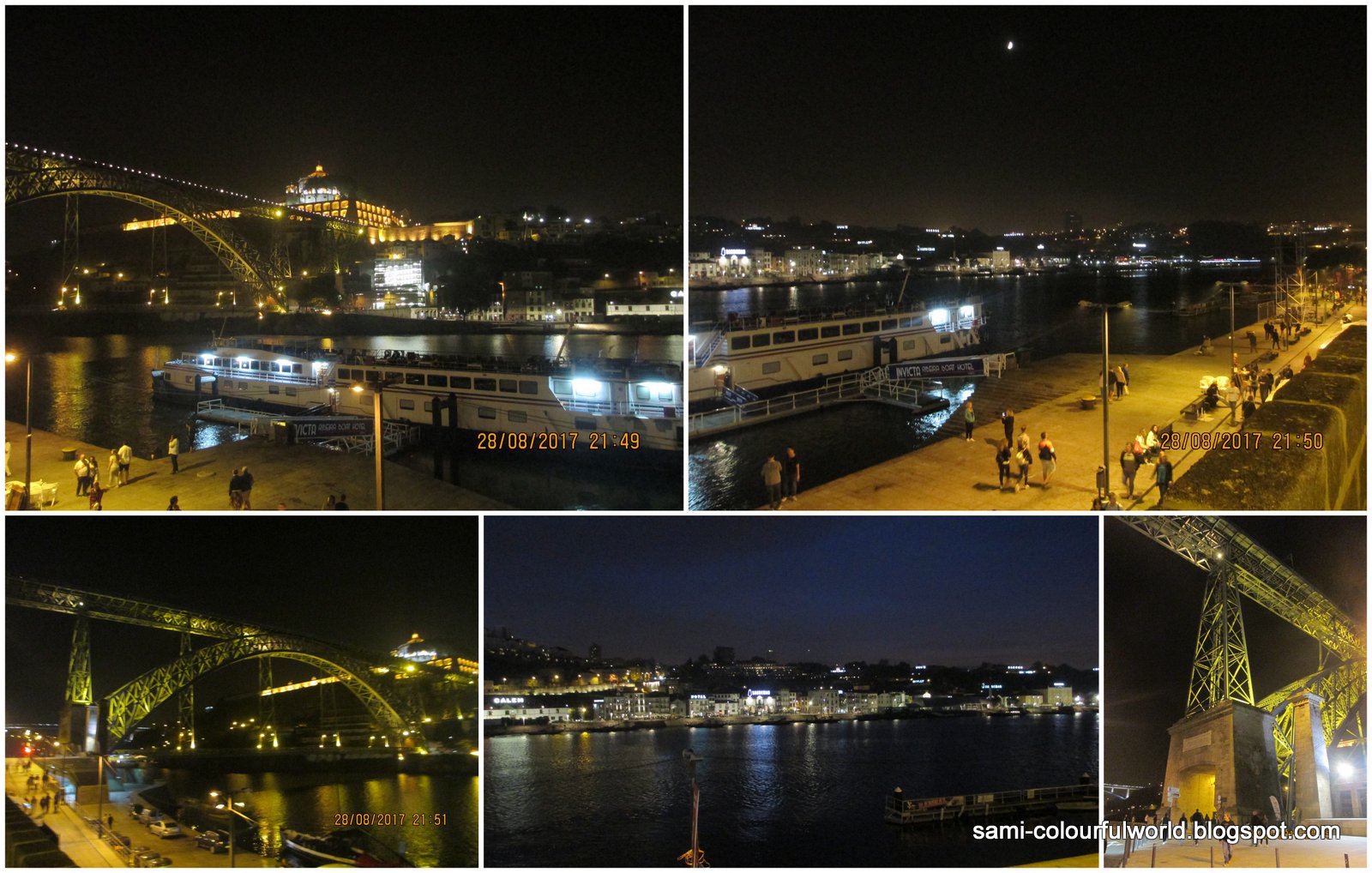
Just at the end of the street was a Church - Sao Lourenco (or Igreja dos Grilos) (Saint Lawrence or Church of Crickets) built in 1577, now a seminary, and there was a lookout over part of Porto that was all lit up by now, and we stood there for a while admiring the view.
When I booked the apartment via Airbnb the outdoor terrace with views over the Douro river was what attracted me to it, and the house certainly didn't disappoint!
It was the ideal spot to watch the sun set or to sit at night with a drink and watch the night lights, just beautiful!
It was aptly named "Oporto best view-garden". Located at Rua Francisco da Rocha Soares, it was also within walking distance to the city centre.

 | ||||
Bedrooms, lounge and the fantastic terrace with river views
|


After settling in, it was time to go and have a bite to eat. Jose and Karina (hubby and daughter) had their hearts (or tummies) set on eating snails. Ugh, I never tasted them... but we couldn't find a place that had them.
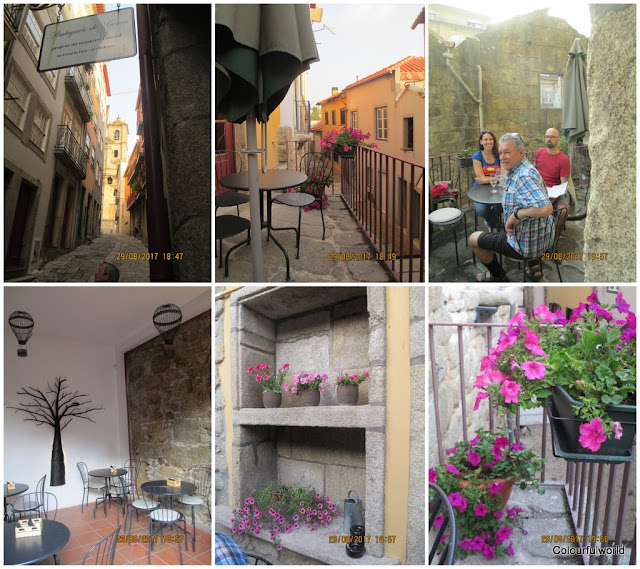
Eventually a young guy from a fancy restaurant - the Old English Club, (old house w/green balconies on photo above) walked us to a lovely out of the way eatery just 500 mt away. No snails again, but certainly a variety of traditional dishes served in a different way.
Português de Gema - at 33 Rua de Santana, is a delicatessen that sells products produced by people with past social exclusion - biscuits, jams, cheeses and pastries.
Vocational training is seen as the key to integration, and here these people sell their products, cook in the kitchen or serve at the tables.
We loved the food, the presentation, the little backstreet balcony full of flowers, the chatty gentleman serving at the table, the cozy atmosphere - it was a pity we didn't get another chance to go back, but if I ever visit Porto again I will, specially after I read about this reintegration project, they deserve our support!


 |
| Views of Porto at the Sao Lourenco lookout |
Time to go home and rest our weary feet, can't believe we managed to do so much, and we walked just over 20,000 steps!
And so ends a photo heavy post, see you back next week for more sights of Porto.
Youtube 3 min video about the 6 bridges in Porto