COLOURFULWORLD

Sunday, 14 April 2013

Coral Bay to Perth - Homebound 1

Day 8 - Coral Bay to Geraldton -  708kms,  9 hours with stops - Part 6

At 9A.M, with the thermometer indicating 32.C. and we are packed and ready to leave Coral Bay on our way to Carnarvon, 237km away. 
Because on the way to Coral Bay we hadn't stopped, we stopped now to photograph the huge termite mounds, some with funny faces drawn on them.

After 9km we turn right and join the Exmount/Minilya Road, stopping again about 30km later to photograph the Tropic of Capricorn sign.
One of hundreds of termite mounds
Tropic of Capricorn sign on the Minilya/Exmouth Road
Another 40kms later we stop for coffee at the Minilya Roadhouse. Here we join the North West Coastal Highway again. Two and a half hours after we started, we arrive in the town of Carnarvon, fill up at a petrol station at 1,675$/litre and make a pit stop at the supermarket to buy some fruit for the trip. 


The dry Gascoyne River near Carnarvon
We drove over the Gascoyne River bridge, the river bed completely dry. This is the longest river in Western Australia with 865km, and flows into the Indian Ocean at Carnarvon. 
The river only flows for about 120 days of the year and below the dry river bed for the rest of the year. In December 2010, (considered the driest month of the year) the worst floods on records were triggered by heavy rainfalls,  of 247mm over 24 hours (average being 5mm a month, and 228mm a year).
Although there were no deaths, entire homes were washed away in Carnarvon and 170km inland in Gascoyne Junction. Carnarvon was isolated due to the flood waters, with the North West Coastal highway shut down for several days. Vast agricultural areas with crops were wiped out and about 2000 cattle died. Some areas recorded water levels above 15 metres!

                                                       * * * * * * * * * * * * * * * * * * * * 

At 1pm. and 120km later, we stopped for lunch at the Wooramel Roadhouse. We had our fish sandwiches (with shredded fish from fish barbecue the previous night) and fruit. It was impossible to eat outside the car as the flies were out in force! It was also quite hot at 36.C, so we managed to get most of the flies out of the car, closed the windows, put the air-con on and sat inside the car eating.
Afterwards we went inside to buy an ice-cream and use the bathroom. Back on the highway, we had 356kms to our overnight stop in Geraldton.


A Road train at the roadhouse
Another pit stop at the Billabong Roadhouse to stretch our legs, and a cup of coffee.
It was now 42.C outside at 2,30h.
We found this sign outside the roadhouse was quite hilarious, just typical Australian humour.
sign outside Billabong roadhouse
On the highway past the Kalbarri Road turnoff we had to go to the side of the road to make way for this monster truck bound for the mines up north. It's arrival was signaled by a police car with a sign, then another car that drove next to the truck (on our lane) and after the truck another car with another sign. I pity those driving behind the truck!


Check the monster wheels!
One of the fancier toilet and eating stops on the highway
At 6,00pm we arrived in Geraldton, drove through town to the southern end and arrived at our accommodation for the night - Belair Gardens Caravan Park.
Our 2 bedroom cabin was wonderful, clean, modern and very comfortable. The bed was probably the most comfortable we had on this trip, the bathroom the most modern too, with an enclosed shower cabin and hand held shower! Bliss!!
At 160$ a night for the cabin it was quite affordable too.

Our little cabin with a veranda too
The lounge/dining room and kitchen
The main bedroom with a double bed and wardrobe
After going to the supermarket for some provisions we made dinner which we ate outside in the little veranda and after a refreshing shower we went to sleep.

Next day: the trip continues with more beautiful scenery and we arrive home.

Tuesday, 9 April 2013

Perth to Coral Bay - part 5

Day 4 to Day 7 - CORAL BAY

We arrived in Coral Bay just in time to watch the sunset on the beach. The tide was low, and some of the tour boats were now resting on the sand instead of in the seawater.
Sunset seen from our accommodation
The tour boats on the sand, when the tide is low
We went into "Bayview Camping" to book our accomodation for 2 nights.
Our intention was to stay 2 nights and then go on to Exmouth 200km north, but on the second day we decided we had enough of travelling and would just stay there two extra nights.

The 2 bedroomed bayview villas facing the beach were beautiful and well furnished - lounge, two bedrooms (one double bed and 2 lots of bunk beds), lovely kitchen and bathroom. The cold water tap in the kitchen had potable water, otherwise the hot water and bathroom/shower water were salty.
We unpacked and the men went off to grill the meat we had in our cooler box (or esky in Australia). 

That first night as we sat outside playing cards after dinner, a little black cat came to us, and started miawing. She was thin and hungry I presumed. We got her some canned tuna and water and she gobbled up all she could.
Pets were not permitted in the camping place, so the next day we queried at the office and at the two supermarkets if anyone had reported a lost cat, but no one knew.
One of the ladies suggested I call the ranger because it was probably a wild cat, but I couldn't do that, the cat was very friendly and seemed to enjoy our company, coming around whenever he saw us sitting outside on the deck, and would just miaw for food, then sit quietly until we went inside at bed time.
The last day I felt sorry to have to leave the cat behind, but we had a 2 day road trip ahead and we already have 5 cats at home. Hopefully he will be well cared for by other residents


The view from the grassed area of our Bayview accommodation
The outdoor decked area of the cabins
Coral Bay, about 1000km from Perth (more in our case as we went to Denham/Monkey Mia), is the gateway to the Ningaloo Reef. The clear turquoise beach waters are ideal for snorkelling, and fish and coral reef as visible not far from the shore.
There are paid activities like Whale watching, Coral viewing on Glass Bottom boats, kayaking, fishing expeditions...
The town is small, clean, has two caravan parks with plenty of cabins, one hotel (Ningaloo resort), a small building with accommodation for the local workers, a Youth Hostel, and a smattering of houses, two mini-markets, post office, bakery and fuel facility.
If you are visiting during peak months it would be wise to book ahead.

Prices are exorbitant, even comparing with the high Perth prices.
Fruit and vegetables are kept in the cold fridges in the supermarket, presumably to last longer - don't know if because they hardly sell them at those prices or to shield them from the heat?
In a coastal area famous for it's fish and fishing facilities I was amazed to find that fish (frozen not fresh either), cost about $60kg! We didn't fill up with petrol, but it cost $1.899/litre, the highest we had seen until then.

Our cabins, at $290 a night (slept 6) was almost double the price of a similar cabin we rented in a Geraldton caravan park, on our way back to Perth, for $160!
But of course we have to pay for the remoteness, the view and the fact that Coral Bay is in the Ningaloo reef area.


Ningaloo - an Aboriginal word that mean Promontory, which describes the projection of land that the coral reef skirts around.

The Ningaloo reef is over 250km long, from Coral Bay to Exmouth, further north. It's not as well know as the Great Barrier Reef on the East coast, but from the amount of foreigners I saw there, it must be getting a lot more overseas recognition...
The coral is just a few kilometres off the coast, with some as close as 100mt from the beach. (called fringing reef, unlike in the Great Barrier reef), and the marine life is rich with over 500 fish species and annual whale shark gathering.

In the morning when we got to the beach, hundreds of seagulls would mingle around the edge of the water picking on tiny fish, and as soon as we put our feet in the transparent water, they would scatter around our feet and dive into the sand...or at least that is what I thought was happening, as they would disappear in a flash. 
When we walked further in, and we had "foot" for about 80 to 100 metres, we could spot a lot of bigger fish through the transparent water (sorry, don't know their type/name?) that seemed curious and swam around us. Once I even saw a Blue Spotted Ray as I walked in the water. It was amazing!
Seagulls at the end of the day - with their bellies full for sure.
We had been recommended a great spot to go snorkelling just off the beach, so we walked south along the sand and water towards the very modern boat ramp/jetty, and half way there we saw the 5 knot sign (for the boats), and walked towards it. As long as the water is turquoise and crystal clear, you are able to stand, and when the water becomes dark blue means it's deeper.

Here we put our snorkel mask on and put our heads down to have a look around.
Well, we, doesn't include me....  I am not too comfortable in deeper water as I don't swim very well and cannot manage breathing under water, and I had trouble "stomaching" the rubber mouth piece. Every time I put that on I wanted to spew...so I lay on a kids body board that I had bought in the village shop,  put the goggles on, and when my husband or daughter pointed somewhere, I would take a deep breath, put my head in the water, look around and bring my face up to breathe a minute later! 
I still saw blue fish, Blue spotted ray, white fish, yellow fish with blue dots....and some brown coral too.
The current and wind brings you back to the north shore, so you have to keep swimming or in my case, kick my feet, to stay in the same area.

I felt sad not to be able to see as much as the family saw but I still felt very brave, as I'm not much of a swimmer.
After a short while I swam back to shore and walked north along the sand back to the main beach where we had left our beach things. Then I sat in the crystal clear waters covered up to my neck, and just stayed there with fish swimming around me.

The water was always so warm, it was heaven! Just my type of sea water. The Perth beach water is too cold for me and I just go in under duress, most times I just wet my feet.


Coral Reef close to the Coral Bay Settlement in Bills Bay
Brown coral as seen in Coral Bay (photo from "Western Australia Travellers Guide)
Coral Bay beach
Seagulls doing their fishing
The low tide with the boats almost in the sand. In the foreground one of the sun shelters

Waters by the Boat Ramp
The modern Boat Ramp
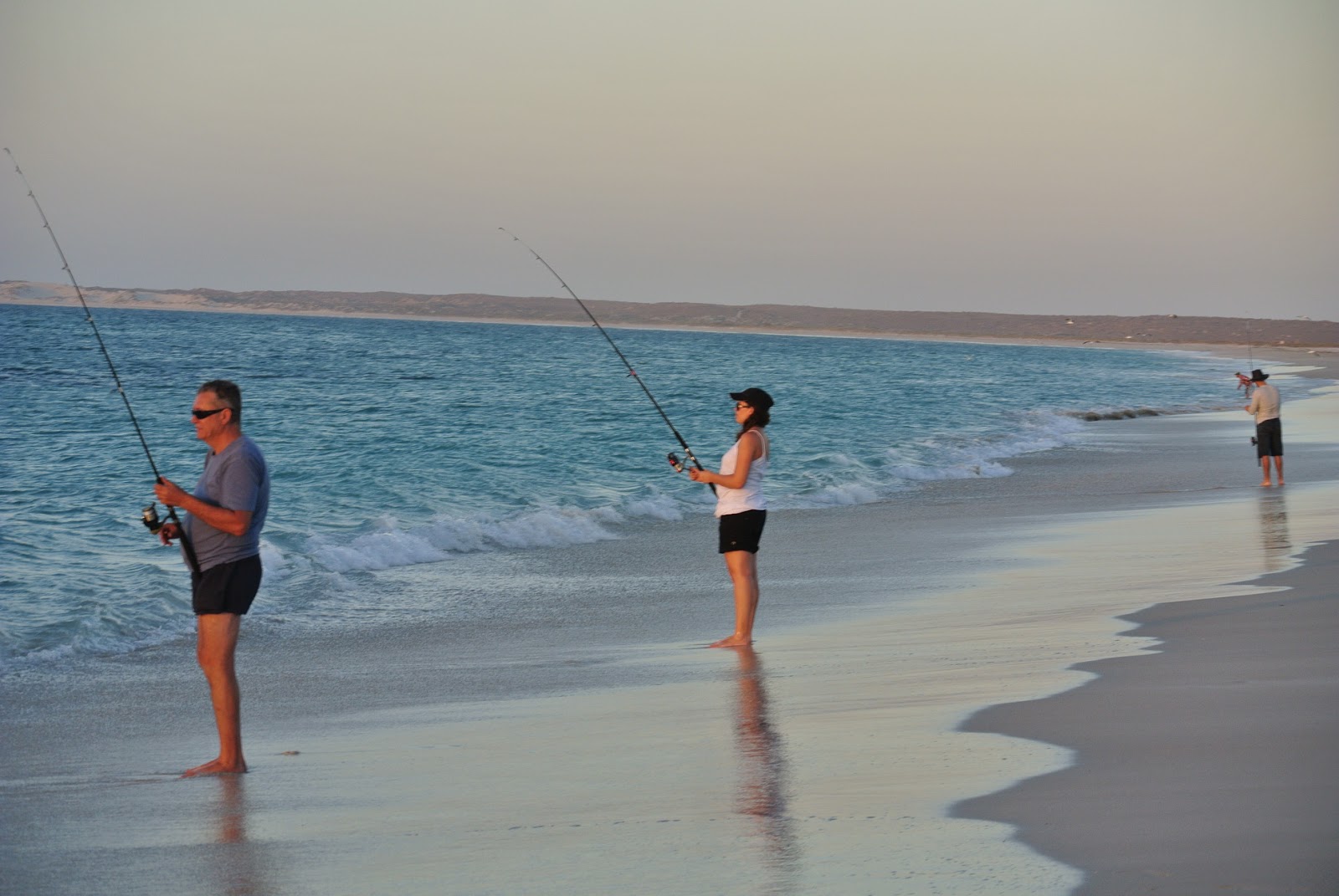
On the second afternoon, we decided to go fishing for our dinner.
We went to Maud's Beach, 4km north and except for me, who sat reading a book, the rest of the family cast their lines, again and again....with no success!
After watching another beautiful sunset we went back home for another meat barbecue.
The family fishing at dusk
Watching the sunset while the family cast their lines
If we got to the beach early, we could get a shade canopy for the day. Otherwise there are a few trees or bring an umbrella.  I was intrigued to see that the beach didn't have many people, even though the camping places were quite full, but a lot of people just sit outside their caravan reading, relaxing in the shade, go to the pool, go fishing...

The second fishing expedition was more bountiful, and after my husband cleaned the fish, we had a delicious fish barbecue with rice and salad I made.

At the end of the day I, along with dozens of people would go to the beach and watch the beautiful sunsets. 
Sunset over Coral Bay beach, with the sun shelters in the distance

On our last evening we decided to spoil ourselves with a dinner at "Finns Cafe". 
Their menu on the blackboard was varied and we really enjoyed what we had. Bring your own liquor (you can buy it at the pub in the Resort). We had made no reservations, the restaurant was full, but managed to get a table. The staff was friendly and atmosphere was relaxed. Who wouldn't like working by the sea wearing shorts and flip-flops as a uniform?

Our 4 days just flew by, we enjoyed our wonderful stay but it was time to return home.
Next post - our return home.


Wednesday, 3 April 2013

Perth to Coral Bay - part 4

Day 4 -  DENHAM TO CORAL BAY via CARNARVON
570km - 9,00h


After a wonderful morning learning and interacting with the dolphins in Monkey Mia, it was time to go back to the town of Denham where we would be spending another night.
On the way we stopped at the Little Lagoon for some photos.
The Lagoon, which is not so little after all, is located 5km from Denham, with very calm turquoise waters, ideal for swimming and fishing. There are barbecues and shade shelters, as well as a walking trail to Denham.
The calm waters of Little Lagoon
The next stop was at the Ocean Park Aquarium, where we spent almost 2 hours on a very enjoyable guided tour around the park. The tours are given by trained Marine Biologists, who teach us about all the marine creatures they have in the park, and are happy to answer all your questions as well.

The have a big variety of sea creatures, such as: eels, a three legged turtle, clownfish, (remember Nemo?), sea anemones, blue spotted stingrays, snapper, tiger sharks, hammerhead, lemon sharks, reef sharks...
The three legged turtle
2 Blue spotted stingray


Lionfish with their toxic fins (fishindexblogspot.com)
We learned about the Lionfish and the very ugly Stonefish....I was already wary of the sea, but I think that after hearing this talk I was pretty scared of putting my feet in the water...

Ufff!! Lionfish have spines in the dorsal fins with a toxic poison, and if you step on them, they release that into your foot. Pretty painful, but the pain  can be relieved by submerging the foot in hot water to inactivate the venom and improve blood flow to the area.

You might need to see a Doctor to get a tetanus injection and to check if no broken spines are in the foot, or check for infection.

Stonefish, are one of the most dangerous and venomous species of fish and their sting could be fatal to humans if untreated within 2 to 3 hours. 

They inhabit shallow waters along the Australian coast, and are well camouflaged in the ocean, often resembling an inoffensive rock. They have 13 sharp dorsal spines on their back that release the toxic venom.

Stonefish  (Synanceia Verrucosa) look like inofensive rocks
The main attraction is of course the live shark feeding, done every hour, with everyone standing on the walkway over the shark pool, the guide dangling a big fish over the water, and the various sharks ripping out bits of it. Scary!!


Some of the sharks in the Shark pool
Dangling the fish over the shark pool, while we watch

Can you see a piece of the fish?


The park is also eco-friendly being powered by the largest private solar installation in Western Australia, (273 kilowatt hours a day) that helps with the reverse osmosis desalination unit to generate fresh water, the park's lighting and pump systems.
Entry to the park costs $20 for adults, and $15 for children over 5, and is certainly a worthwhile place to visit. 
Back to Denham, 7km from the Ocean Park, and we parked the car at our residence, and took a walk around the town.
The local church made of Cockle Shells, as well as a local restaurant - "The Old Pearler"  were duly photographed, and after having a look at the menu we booked a table for 4 for dinner.
As I photographed the church, I saw an Emu "walking" along the road, crossed the street and eventually disappeared into a vacant block of land... (photo below). Strange sight...
Denham church made of cockle shells


An Emu crossing the road, across from the Church
The Old Pearler Restaurant, also made of cockle shells


The restaurant, which claims to be the only restaurant in the world made of cockle shell bricks, has a nice atmosphere, good service, food was also quite enjoyable, prices above average. 
The Grilled Seafood Platter for two was $98 or $53 for one, included whiting, prawns, squid, oysters and crayfish. I went with the Chicken with mustard seeds, served with chips $32, which was quite a plateful, and I needed some help to finish!
If you drink take your own alcohol or go across the road to the Bottle store, as the restaurant doesn't have an alcohol licence. The 4 of us shared two desserts, but I was a bit disappointed with my choice - Mango and Marsala cheesecake, which didn't taste of mangoes at all.


Bring your own alcohol, or buy at the Bottle store across the road
Inside the Old Pearler Restaurant
After a good night's sleep, we were on the road again at 9AM, after having topped up the tank, at Denham, this time paying $1,749/litre (previous one had been $1,699).


First stop for a photo of the crossing of the 26th Parallel, which we hadn't photographed on the way into Denham.


Next stop, Eagle Bluff, 18km out of Denham, named after the Sea Eagles which nest on the rock islands just offshore. It has a boardwalk over the ocean from where you can see marine life on the shallow waters below - fish, rays, turtles, dugongs...  We didn't see anything, but it was still a nice place to visit.
Eagle Bluff is also the place where Captain H.M.Denham, carved an inscription on a rock in 1858. The rock is now in Pioneer Park in Denham.

Eagle Bluff boardwalk
Eagle Bluff - no marine life seen in the waters...
Back in the car for a quick hop to Shell Beach, 36kms away. It's apparently one of the world's two Cockle Shell beaches, and it truly is an amazing sight!! 
Miles and Miles of tiny shells! 
These shells known as Hamelin Cockle (Fragum erugatum) exist in prolific number because of the high salinity of the water and lack of predators. The beach is up to 1km wide, 110 kilometres long, and the depth ranges from 7 to 10 metres.
The water is crystal clear in tones of blues and greens.
Over time, the shells formed a limestone known as Coquina - as used for the construction of the Church and Restaurant in Denham. The Coquina is no longer mined, since Shark Bay became a World Heritage Site.
On the down side, Eagle Bluff and Shell Beach were the first areas where the flies were in abundance and quite pesky. The temperature was already 37.C at 10 A.M!

Miles and Miles of Cockle shells in Shell Beach


Close up of the shells, they are tiny!
Another 50kms down the road, towards he North West Coastal Highway and we drive past the Hamelin Pool turn off. Two of the troupe were already sleeping in the back seat, and we decided to carry on and give it a miss. 
The attraction would be the Stromatolites - living fossils in old rocks. We would be going to see the ones near Cervantes on our way back to Perth...

We reached the highway and turned North on our way to Carnarvon, and stopped again 70kms later at the Wooramel Roadhouse, for a pie and ice cream.
It was now 42.C at 12 o'clock!
140kms and one and a half hours later we arrived in the town of Carnarvon.
Just before arriving the temperature had climbed to 44.C!!!
In Western Australia they say - in winter go North (there is no winter in northern W.A) and in summer go South (it's cooler), and they are quite right!

The temperature as we reached Carnarvon!
We looked around for a place to eat a quick lunch and settle on the Carnarvon Hotel Pub, in Olivia Terrace, overlooking the sea. It was cooler inside, and we ordered fish and chips and burgers. Everything seemed to be fried and accompanied by chips! The portions were generous and surprisingly tasty, and reasonably priced at an average of just over $20 each including drinks.
Carnarvon, a town 900km north of Perth, lies on the mouth of the Gascoyne River on the Indian Ocean.
The town is know for it's fruit production - bananas, mangoes, tomatoes, for the salt mining, fishing (prawns) and cattle, sheep and wool.
The Mile long Jetty, as seen from the Carnarvon Hotel
Before leaving town we drove into a fruit farm on the outskirts of town and bought bananas and the last of the mangoes. I wish the farmer had more as they were very sweet and tasty.
Banana plantation
In the 1960's, Carnarvon was the centre of NASA's communication, with a tracking station built there on the hills, to support the Gemini and Apollo space programs. It was closed in the 1980's.
The dish in Carnarvon
We didn't have time to climb up to see the dish or the view over the town, as we wanted to reach our destination 240km away, before night fall.
Another quick stop at the Minilya Roadhouse, 145km after Carnarvon, to fill up the tank, petrol costing $1.809/litre, up again from the previous time in Denham, at $1,749/litre.

We reached our destination in Coral Bay around 6,30h just in time to see a beautiful sunset on the beach.

Next Post - our 4 day stay in Coral Bay and my snorkeling attempt.