Thursday 23rd September - We checked out of Cooinda Lodge after breakfast at around 9AM .
Our cabin was wonderful and comfortable, and included Continental breakfast.
I never used any of the 2 pools, but we were always on the go... the grounds were beautiful and lush.
 |
Our cabin (top left), the grounds with cabins, the glamping area, the 2 pools
|

 |
| Some of the beautiful flowers in the Lodge's gardens |
Our first stop just 2km down the road was at the Warradjan Cultural Centre.
The Aboriginal clans of this area - Bininj/Mungguy recognize 6 seasons, which is shown in the plaque at the entrance to the centre.
 |
| The 6 Aboriginal seasons |
 |
| Boh Boh = Bye |
This free Aboriginal round shaped museum, designed to look like a pig-nosed turtle (Warradjan), and also reflecting the fact people sit in circles at gatherings, has interesting exhibits with stories by traditional owners of their upbringing in Kakadu. You gain an insight into the complicated kinship laws of Aboriginal people, how food is hunted and eaten, and the artifacts on display are all made by the Aboriginal clans of the area.
Back on the road, we encountered a few buffalo crossing the road...

Almost 2h later we stopped at the former gold mining town of Pine Creek, originally built in the 1870's when gold was discovered in 1871 by workers building the Overland Telegraph Line. The small town of 328 residents is at the junction of Stuart and Kakadu Highway.
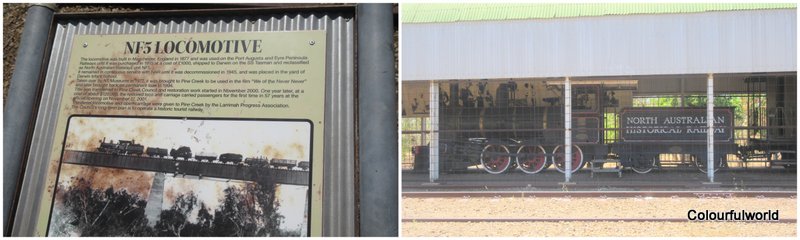
During our short stop 3 of us wondered around and came across the former railway station (1888) now the town's museum. Out of nowhere a lady came to greet us and opened the doors so we could see inside. Entry is by gold coin donation ($1 or $2).
The railway museum/former station was the southern terminus of the Darwin line until 1914, but the line closed permanently in 1976. There is an operational 1877 Beyer Peacock NF class steam locomotive, as well as a former Western Australian Government Railways TA class diesel-electric shunting engine. Sadly no train driver to operate them. The well preserved railway station has been added to the Register of the National Estate in 1980, and the Northern Territory Heritage Register in 1994, and includes restrooms, parcel office and waiting room, goods shed, loading bank, weighbridge and crane.
 |
| The railway station/Museum and some of the old treasures inside |
Back on the road, as we left Kakadu National Park we stopped to take a group photo at the Kakadu sign - it's actually seen as you enter the national park from the Katherine side, but the one on the way in from Darwin is not as pretty, so the tour guide, said we would stop at this one for a group photo (still not uploaded to his website).

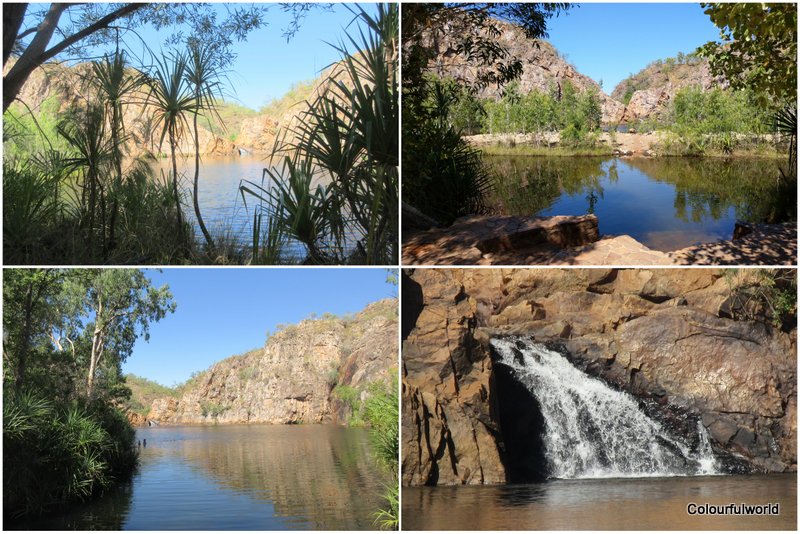
About 42km north and then 19km inland via a sealed road, we reached (Leliyn) Edith Falls, where we stopped for lunch and then a dip in the pools.
The Cafe was full of people, but service was quick. I thought it was funny that the lady taking the orders added everything on a piece of paper without a calculator!

As we descended a few steps to the outdoor eating area, I noticed the wooden balcony rails were full of funny signs - some of them old advertising signs, and I had a good laugh at some of them.
The home-made chicken pie I ordered wasn't much to my taste, a bit sweet with too many carrots...
 |
The quirky restaurant at Edith Falls - signs, animal figures in the garden... my chicken pie
|
 |
| Great Bowerbird near our table |
After lunch those who wanted to swim changed into their bathers in the toilets and walked down to the pool and falls.
 |
The bathroom building had Aboriginal murals all around and Aboriginal signs indicating men and women
|
As I prepared to enter the water the older couple in the group was talking to 3 young guys and asking where they were from - an American, and Israeli and a Portuguese!
The couple pointed to me and said "She's also Portuguese". I turned back and introduced myself to the 3 young men, and then spoke to the Portuguese guy. As soon as he opened his mouth I recognized the typical accent from the Azores Islands. He was from São Miguel Island, where my husband and his family are from. They were on a working holiday which had been extended due to Covid and were travelling in the Norther Territory and eventually would make their way into Western Australia. They will eventually get to Perth and I gave him my contact so they could come to dinner once they arrive. He was thrilled to have met someone who spoke his language, and more so that my husband was from the same town. The Azoreans tend to go emigrate the States or Canada, so I think he wouldn't find many in Australia.
With all the chatting, I only got a chance to have a quick dip in the cool water, but the pool was quite large and beautiful, surrounded by paperbark and pandanus trees and waterfalls on one side.
 |
signs on the way to Katherine
|

Forty five minutes later, we arrived at our final stop for the day, the town of Katherine- the third largest town in the Northern Territory famous for the Katherine Gorge in the Nitmiluk National Park and the Cutta Cutta Caves.
Situated 320km south of Darwin, with about 6300 residents, Katherine is also known as the "world's largest classroom", because of its School of the Air, established in 1966 providing education to students in remote and isolated locations. Classes were originally conducted via HF radio broadcasts, but thanks to the internet and satellite communications radio broadcasts are no longer used. It caters to about 250 students up to year 9 in an area covering 800,000 km2 (310,000 sq mi).
The town has also developed as a regional centre supporting the cattle, horticulture, agriculture and tourism industries.
We settled into our accommodation for the night - the Knotts Crossing Resort, 3km out of town. It was a simple brick building with rooms end to end, but the beds were comfortable and dinner and breakfast were included in the price.
After a quick freshen-up, the 3 of us decided to go into town for a walk around and have a drink at the pub.

The reception clerk ordered us an Uber who dropped us off in the main street and we walked around admiring the many murals and quirky signs in the main street.


We reached the bridge at the entry to the town, that our guide had pointed out when we drove in, with the markings above where the floodwaters climbed.
 |
| Katherine Bridge |
 |
Katherine River
|
On Australia Day (26 Jan) 1998, during 2 days, the worst flood on record devastated the town, and the area was declared a national disaster. The flood resulted from the 300–400 mm of rainwater brought by Cyclone Les that caused the already full Katherine River to peak at 20.4 metres (66,93ft). The floodwaters inundated the town and surrounding region, requiring the evacuation of about 3000 of its 11000 residents to higher ground. The flood covered an area of 1000 square kilometres, affected 1100 homes and cut off many roads in and out of Katherine and three people drowned.
Sadly many people left Katherine after this flood and never returned because of what they had suffered and lost.
In April 2006, again floodwaters reached a peak of nearly 19 metres (62,33ft) at the Katherine River bridge, placing parts of the town under water, with some houses having up to 2mt (6,56ft) of water, causing millions of dollars in damages. Over 1100 people took shelter in evacuation centres, escaping with little more than the clothes they were wearing.
Back to the centre of town we went into the pub at the Katherine Hotel and took our drink to the quirky patio area at the back.


After sundown we called a Taxi, waited and waited for about 20 to 30 min. Two phone calls later a taxi showed up and returned us to the our accommodation in time for dinner. Our tour guide Paul joined us and we got to hear a few of his funny on the road stories.
My Carbonara Pasta serving was gigantic, as were most meals served to us in every restaurant in the Northern Territory, but it delicious.
Time for bed, as we were checking out of the Knotts Cross Resort after breakfast the following day, to visit the Katherine Gorge and then back to Darwin.
Map of our itinerary from Cooinda Lodge (Kakadu) to Katherine:
We covered about 300 Km (186 miles) from 9am to about 3pm.