COLOURFULWORLD

Thursday, 12 July 2018

Sydney - Castlecrag and Chatswood - day 4

Saturday 16th June, was a lovely sunny day and after a leisurely breakfast I tidied up the little granny flat where my husband lives, while he replaced my mobile battery....or should I say he managed to destroy my phone, as the screen is frozen, and I'm unable to use it!
I was upset as I had no idea the operation might not work out or I would just stick with charging the phone twice a day as I was doing instead of replacing the battery...

Anyway, Jose had with him a mobile that a friend had given us when we went to Europe in April, so he put my Sim card in that phone and set it up with all my apps and accounts, which was good, but I still can't get used to that phone and I'm hoping my tech-savvy son will be able to rescue my mobile one of these days.

After that we decided to go for a "countryside" walk. 
We took the 206 bus from Middle Cove and alighted two stops later at the Quadrangle shopping village on Edingburgh Road where we started our 1,5km walk towards  Sailors's Bay via curved streets with names of parts of a castle - The Rampart, The Scarp, The Bastion, The Citadel...

At the entrance to the affluent suburb of Castlecrag was a lovely green sculpture with water running down it - The Griffin Memorial fountain by sculptor Bim Hilder  from 1965.
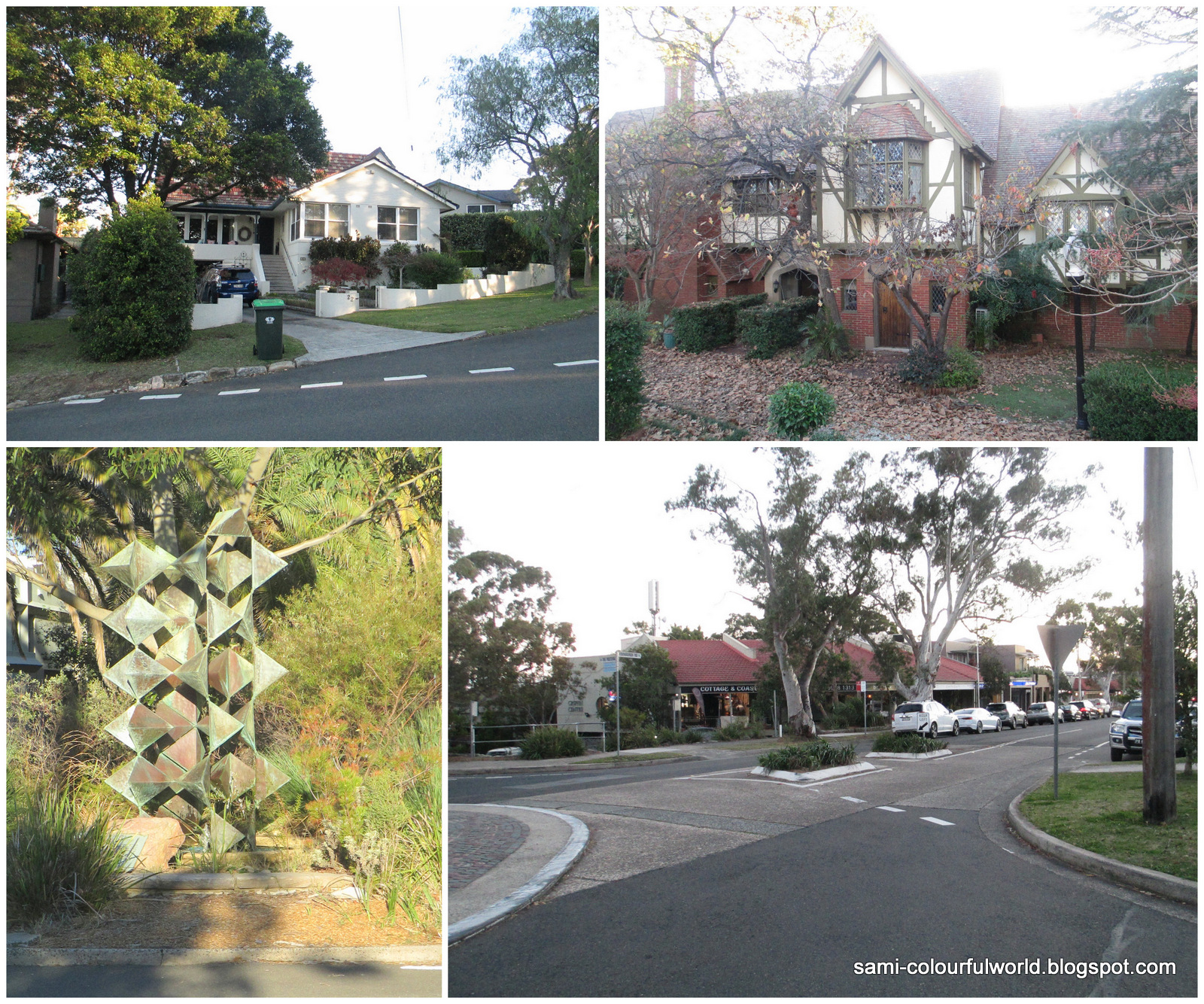

Some of the houses, The Quadrangle shopping centre and the Griffin Memorial fountain

 Castlecrag area was originally owned by a struggling London based company who though that the steep and rocky area was unfit for development, when in 1919 American architect Walter Burley Griffin in partnership with the Greater Sydney Development Association made them an offer to buy 650 acres with more than 6km of water front land and got it at a lower than anticipated price. 


Walter wanted to design a model suburb sympathetic to the Australian natural environment where town planning should respect the natural character of the site's landscape and also focus on establishing a sense of community in the suburb.
Together with his wife Marion Mahony Griffin also an architect and landscaper, they designed and helped build 15 houses in the suburb which were characterised by the use of concrete and stone found at the site matching the natural surroundings, flat roofs to avoid obstruction of views, and with the living rooms at the rear of the house facing views or parks.

On researching Mr Griffin I learned that he won a competition to design Australia's capital - Canberra - and Mrs Griffin was one of the first licensed architects in the world and equally responsible for the design!  A decade later they embarked on the Castlecrag development and subdivision project.

The curved roads lead us to a narrow street downhill to the Middle Harbour peninsula.
Sailors Bay  was at first hidden from view by lots of trees and then all of a sudden there it was, the calm water, the dozens of boats, multi-leved houses on the margins, the sun casting it's golden glow on the water ...  Magical!!

A couple of men worked on their boats, painting, fixing motors...while we walked around admiring the views and the calmness around us.  We had thought we would find a coffee shop down there, but sadly no such thing.


Eventually we gathered our strength to start the uphill climb, very hard on the knees and legs, lol...
There was a bench, and other small statues along the way which had a QR code which my husband read with his QR scanner on his mobile, depicting the story of the suburb and Walter Griffin.


We were back at the Quadrangle shopping village at around 4pm, and decided to take the bus to the suburb of Chatswood, a 30 minute ride, to go and have dinner there and also watch the Chatswood lights festival.
It wasn't as impressive as the Sydney Vivid lights festival of course...but we still had a great night out. The lights went on at 5,30pm and we sat on the steps of The Concourse watching the show for a few minutes.


The Concourse (photo from the net)
The Concourse is an entertainment venue home to a range of live arts, function centre and conference facilities.
The 360 degree projection with NASA's imagery took viewers on an immersive dive into the universe, the stars and the planets.


The main street and a couple of side streets were closed to traffic and the area was full of families enjoying the lights festival, eating out at the numerous food stands.
All of a sudden we saw a group of youngsters "playing drums" on tin cans and on the common Australian rubbish bin, their clothes covered in lights. The Junkyard Beats, were very popular and had the crowd following them all over the street.  I loved it too, it was fun.

The Junkyard Beats
The Westfield shopping centre also lit up, the Junkyard beats headquarters, a sea of pink balloons
Other Light installations
After wandering around we couldn't decide on what to eat from the food stands and decided to go eat an hamburger and sweet potato chips at Grill'dthey make great and "healthier" burgers.
And after a main meal what better than a Belgian waffle with chocolate sauce for dessert, from one of the food stands?  That was a bit too sweet for me actually, but I ate anyway!

From a lot of the advertising, shops, street names, and the people around I gathered that Chatswood has a big Asian community as everything was written in Mandarin? and I even saw an Estate Agent whose window adverts for houses to rent or sell were just in Chinese characters.  I actually found that to be unacceptable, as we are in Australia so why should everyone who doesn't speak that language be excluded?

Our Belgian waffle, the food stands, one of the Chinese translated adverts
And at about 10pm we were done with our sightseeing and walked to the bus stop right by the station and caught a bus home.

Monday, 9 July 2018

Monday Mural - PS I love you

On a building next to the St. Andrew's Presbyterian Church now Bavarian Beer Cafe outdoor eating area, at Phillip st, Parramatta this gigantic mural caught my attention.
The 5 storey high, 150sqmt/1614sqft mural was painted in November 2016 by Steen Jones, a Brisbane based artist.
Not very easy to photograph as there was a canopy over the eating area blocking the full view and from the street side the trees were blocking it too.


St Andrew's church and the mural

If you like murals or have a mural you'd like to post, this meme is for you; just follow the Linky steps below.   Be sure to link back to this blog and visit your fellow posters. Looking forward to your mural finds this week.  Thanks.


Thursday, 5 July 2018

Sydney - Parramatta - day 3

Friday 15th June - My friend Bebe who lives in Sydney's western suburbs had invited me to join her for the day, so she could show me around Parramatta, where we could visit a few heritage buildings.

I took the bus from the suburb of Middle Cove into the city and walked from the last stop in Bridge street to Circular Quay station. On the way to the station I spotted some statues in a small park and also visited Customs House just across from the station.


Street art in Sydney

Customs House is an historic landmark in Sydney, built in 1844-45 in response to Sydney's growing volume of maritime trade and has since 2005 been the home of the Sydney city library. They also have on the ground floor (or first floor for the Americans, as Elizabeth informed me recently) some comfortable chairs and an array of foreign newspapers which seemed to be a popular section.

On the ground floor too is a glass floor and underneath you can see a scale model of Sydney's centre complete with the bridge, the Opera House, etc.

Custom's House, foreign newspaper room and  cafe/restaurant


Scale model of Sydney's CBD

After the short visit I caught the blue line train to Granville, and half an hour later my friend was waiting for me just outside the platform.

We got in her car and drove to the Western Sydney University campus to visit the Female Orphan School that operated in one of the buildings right across the Parramatta river.
The school operated from 1813 to 1850, giving girls the skills for them to work as domestic servants and escape a life of poverty, immorality and prostitution. Many of the girls were in fact not orphans, but had only one parent who was living in poverty or was ill or convict parents. Their ages ranged from 3 to 13 and places at the school were sought after.

The building is also the oldest three-storey building in the country and after its life as an orphanage it served as a psychiatric hospital until ideas about mental health changed and the building became disused by mid 1980's.
The University took over the restoration of the building and it is now the home of the Whitlam Institute.


Sadly not much is left alluding to the orphanage or the psychiatric hospital with only the wall adjoining the staircase showing the original brick and wallpaper and a few old bathroom basins.
On the top floor on one side of the building was an exhibition - Blaze: Working women, Public leaders - about New South Wales women leaders in the public sector.
On the other side was the Whitlam Institute and Whitlam Prime Ministerial Library, the public institute that commemorates and is inspiring by the life and work of the Hon. Gough Whitlam AC QC, with more than 35 thousand objects that capture the personality, public life and government of Australia's greatest reforming Prime Minister from 1972 to 1975.  He died in 2014 at the age of 98.

Right next to the river is a small cottage that is the office of the University's Deputy Vice-Chancellor.


Parramatta River, Deputy vice-chancellor cottage and various metal artworks


Another renovated building in the campus is the 1894 Boiler house - where 2 steam boilers generated power to cook meals and provide hot water for laundry and bathing of the nearby orphanage/psychiatric hospital.  The building was destroyed by fire in early 1990's and has been transformed into a stylish restaurant and outdoor noodle bar, that adds a vibrancy to campus life.  In 2012, the building won an award for adaptive reuse of an historic building.
On the outside wall are a couple of industrial washing machines, and the boilers and other old machinery have been displayed around the campus and restaurant.
On the brick side of the house on the left was a ceramic mosaic of Mrs Elizabeth Macquarie (1778-1835) the wife of the 5th Governor of New South Wales who took particular interest in the welfare of women convicts and indigenous people.
The mosaic by Michael Keighery was commissioned in 2011 and is made up of thousand of individual photos.
On researching this mosaic I've also discovered that there is a University Sculpture walk.

The boiler house, and mural of Elizabeth Macquarie 


From here we drove to Parramatta Park where we parked near Gatehouse Tea rooms where we had something light to eat for lunch - my friend Bebe ordered a Savoury muffin with salad and I had a baked Egg frittata with salad. The cafe in the 1887 Old Governors gatehouse is quaint, food was delicious and the service very attentive. 

Next we went across the park to visit Old Government House, the former country residence used by ten former New South Wales governors between 1800 and 1847.
In 1799 the second Governor erected a building on this site, and in 1815 Governor Lachlan Macquarie and his wife Elizabeth, added to the building, which resembles the building today. The elegant Old Colonial Georgian style building is furnished in the 1820's style and is Australia's oldest public building. 
There was an exhibition about Governor Macquarie and his link to Indian culture, spices and plants that he brought to Australia on his travels to India.


Old Government House back and front , the dining room and entrance hall

Kitchen and Indian spices, Indian robes, Indian plants brought to Australia

The bedrooms, embroidery from the 1900's and men's dress jacket


On the way to Bebe's home she drove by St. Andrew's Presbyterian Church at 2 Phillip st, built in 1925-26 and was known to have one of the finest organs in the State. 
In 1990 a new parish was opened in North Parramatta and this church closed. In 1997 the church was sold for $1,580,000 and has seen a range of retail uses such as a restaurant, nightclub and bar and is since 2008 the home of the Bavarian Bier Cafe.
Luckily the facade and hall of the former church as well as the stained glass windows have been preserved in their original condition.
I went inside to take some photos and was awed by the wooden roof trusses, the stained glass windows, the pew style benches.
One of the waitresses came to ask if I wanted to be seated and I said I was just taking photos and she said the Bier cafe would actually be closing soon for a short while for safety reasons, as there was a building going up next door.  I just hope the church is kept intact!


And so ended our day of sightseeing around Parramatta. 

At Bebe's house she showed me the latest renovations they've been doing to their house and then we sat for a while chatting about genealogy and looking at her collection of cooking books.
When my husband boarded the train in Sydney he called me and Bebe's husband picked him up from Granville station half an hour later.
We then went to dinner at one of the Indian restaurants in Parramatta in a street packed door to door with Indian restaurants!
I forgot to take photos of the name of the restaurant or the food, but we had a great dinner, our friends insisted on paying for dinner and then still drove us home, a 45 minute drive!

A big thank you to two lovely people who provided us with a great day.

Monday, 2 July 2018

Monday Mural - Budapest isn't small

On this 245 sq mt (2637 sq ft) wall in Kazinczy street in Budapest, is a map of the city saying "Budapest isn't so small" (Budapest nem ekkora) painted by Richard Orosz. The artist's intention is to draw attention of the tourists in District VII (Jewish quarter) to visit other areas of Budapest just a short distance away.
Just under the map is the phrase " Budapest is much bigger than you think and there is life beyond it".


Friday, 29 June 2018

Sydney - Vivid Lights Festival at the Botanic Gardens - day 2 PM

After my long day of walking around the Botanic Gardens and visiting a couple of Museums, Jose met up with me after work at Wharf 5 at the Circular Quay (ferry and train terminal).
We decided we would go to the Botanic Gardens to see the lights festival, so we walked towards the Opera House which was the nearest entrance to that area.


There were thousands of people in line to go into the park, and they had made it so that after seeing the show people came out through another gate, so it all flowed pretty well. 
Of course at the other end people were upset they weren't allowed in and had to walk further down to the other gate! Someone at the door had a click counter so I wonder if there were more than the 450 thousand visitors they had in 2017!
The lights didn't disappoint of course, you can see some of these photos I took on my morning walk without the lights on my previous post.

The 8 metre wide crocheted Hyperweb 6 metres up in the air, the sails of the Opera House, the city buildings...


The Nautilus Forest with 24 "trees" and 40 thousand lights came alive with the changing colours.


A lot of families were walking around with kids who were having a great time interacting with some of the displays, like the Aqueous (bottom right) where they could jump on the pathways and enjoy the changing colours and light intensity.
The 5 metre wide Bloom  (top left) illuminated with over 1000 bulbs could also be used to take a photo with your face in the middle, and Snugglepot and Cuddlepie, the May Gibbs book characters were also present.


Government House was the highlight for me, with the facade constantly changing with various motifs that celebrated Australia's art and cultural iconography. Sadly my photos don't do it justice.


When we left the Botanic Gardens at the other end we walked towards the Rocks area to have dinner.
On the way, just behind Circular Quay was Customs House where we stopped briefly to see the story of "Snugglepot and Cuddlepie" unfold on the facade. Written by Australian artist and illustrator May Gibbs about 100 years ago, Snugglepot and Cuddlepie are two little gumnut brothers who set off on an adventure to see a human, and on the way encounter other creatures.
If you have 10 spare minutes you can watch the whole show that a very patient person posted on youtube 😉.

Customs House and the story of Snugglepot and Cuddlepie

The Rocks also had buildings on the main street lit up, plus other fun installations and a few trees with either white, purple or blue lights - magical.


We decided to have dinner at Shiki Japanese restaurant, on the Clocktower building and were given a great table right by the window, from where we had the view below.
The food was fabulous, the service very good and professional, prices were above average but in keeping with the suburb.

Our various dishes

View from our table at the Japanese restaurant
                                                                                              
The Clocktower building - with Shiki restaurant on the first floor, where the two arches are, and our table was the one on the left.
A short Youtube video of the Vivid Sydney Lights festival of 2018.