Day three started with us having breakfast at a nearby coffee shop - Cafe El Reys, just across from Jardim das Virtudes (Garden of virtues).
Situated just behind the Court House, this vertical garden is apparently not a very well known garden with the locals, and even I didn't get to go down the park as I had no idea where the entry was. Next time!
At the top there were some statues and an old fountain built in 1618, at the end of the street. The supporting wall was around the garden was built in the 18th century. The views over the river were spectacular.
 |
| The horses statue is called - The 4 cavaliers of the Apocalipse,1956/ Old fountain/ View over Porto |
Carmo & Carmelitas Churches
After breakfast we walked about 600mt to find two churches, which are just across from Porto's university building in Rua do Carmo, and located close to the Clérigos Tower, Cordoaria Gardens and Lello Bookshop.
The two churches are separated by a 1 metre wide house which was inhabited until the 1980's. It was built due to a State rule that two churches couldn't share a wall, and also to ensure chastity between the nuns and the monks of either church.
I wonder if they didn't see each other outside church?

 |
| Carmo and Carmelitas churches |
On the left Igreja dos Carmelitas (Carmelite church) - was built in the mid 17th century, completed in 1628.
With a granite facade, the 3 arched entrances topped with statues, the bell tower is covered with blue and white tiles.The church was used as barracks during the French Invasion of Porto (1808-1814).
On the right, Igreja do Carmo (Carmo Church) - was built between 1756 and 1768 in a rococo or baroque style, and has one of it's exterior walls covered in blue and white tiles (azulejos) which were added in 1912, depicting scenes of the founding of the Carmelite order in Israel. They were designed by Silvestro Silvestri and made across the river in Gaia.
Lello & Irmão Bookstore
Just down the road, is Lello bookshop, which is considered one of most beautiful bookshops in the world.
Founded in 1881 the bookshop moved into the current building in 1906.
The building has a Neo-gothic facade with figures representing Art and Science.
The interior is stunning and was designed by Xavier Esteves, with a marvelous red staircase in the center, wooden walls, stained glass ceiling with Lello's motto - "decus in labore" (There is honour in work).
It's rumoured that J.K.Rowling's inspiration to write Harry Potter began in this library. The well known writer lived in Porto for 10 years in the 1990's working as an English teacher.
I haven't read the books or seen the movies, (sorry to all the fans, but not a fan of fantasy) but apparently there are similarities between Lello's library and the one in Hogwarts. Also the Hogwart's black capes could have been inspired by the University capes students use in Portugal, and Porto's university is located near this library.
With all the fame, the only way to visit this bookshop is if you a ticket (€4) which can then be redeemed if you purchase a book - English and French books also available.
When we saw the huge queue to go in, my husband and son in law gave up straight away and scurried across the road to the coffee shop.
 |
The Lello building, the doorman in a fancy suit, our tickets, Centenary of Lello bookshop in 1981
|
It's rumoured that J.K.Rowling's inspiration to write Harry Potter began in this library. The well known writer lived in Porto for 10 years in the 1990's working as an English teacher.
I haven't read the books or seen the movies, (sorry to all the fans, but not a fan of fantasy) but apparently there are similarities between Lello's library and the one in Hogwarts. Also the Hogwart's black capes could have been inspired by the University capes students use in Portugal, and Porto's university is located near this library.
With all the fame, the only way to visit this bookshop is if you a ticket (€4) which can then be redeemed if you purchase a book - English and French books also available.
When we saw the huge queue to go in, my husband and son in law gave up straight away and scurried across the road to the coffee shop.
My daughter and I bought the tickets, which are sold at the adjoining shop, where you are able to take photos of some "staged props" and you can buy postcards, books, crafts, etc.
Then we went back outside to join the long queue that went around the building. It only took us about 20 minutes before we were able to go in, so it wasn't that bad.
The bookshop is indeed very pretty, although there were so many people it was difficult to get a good photo without dozens of people in them!
Then we went back outside to join the long queue that went around the building. It only took us about 20 minutes before we were able to go in, so it wasn't that bad.
The bookshop is indeed very pretty, although there were so many people it was difficult to get a good photo without dozens of people in them!

 |
| Me on the staircase, intricate wooden rails, stained glass ceiling |
I bought a health book and story book for grandparents to read to grandkids, and both of us were able to get our entry ticket rebated in the price.
If you peep outside the windows you are able to get a good view of the Jardim das Oliveiras (Olive grove garden) with 50 olive trees and the Clerigos Tower across the park. (It was actually very foggy, so couldn't see too much beyond).
The Olive Grove Garden built over a parking garage at Praça de Lisboa (Lisbon Square), was a successful project that brought people and commerce to this area of Porto.
At one end of the park is the statue of D. Antonio Ferreira Gomes, a Catholic bishop
At one end of the park is the statue of D. Antonio Ferreira Gomes, a Catholic bishop
that fought against the fascist regime in Portugal.

| View from Lello bookshop over the Olive Garden, where Jose and Thomas were having a coffee, and Clerigos Tower |
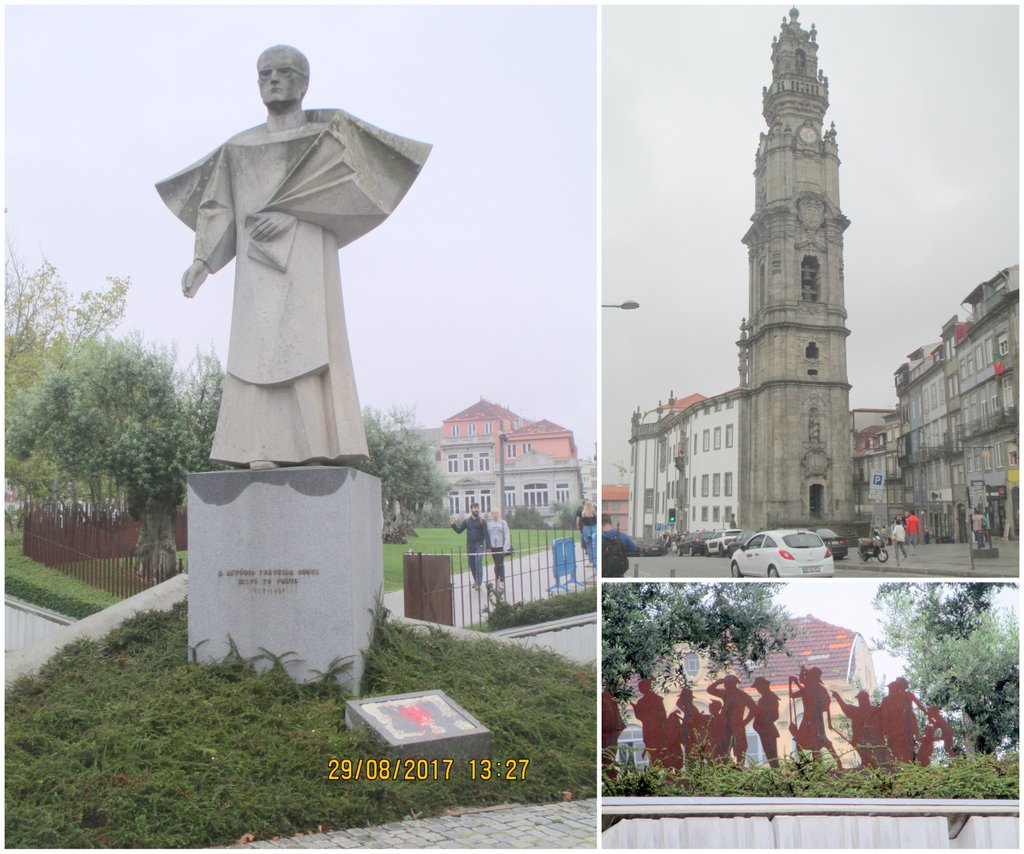 |
| Clerigos Tower and statues in the park (Antonio Ferreira Gomes) and other |
After the visit to the bookshop we walked 5 min. until Rua da Flores to find a place to have lunch.
Rua das Flores (Flowers street)
Near São Bento station, this street in the heart of Porto is a hive of activity from morning to night.
The buildings have been renovated, the electricity boxes are decorated with drawings (murals), there are plenty of coffee shops, boutiques, delicatessen...
Once more I found beautiful doors and windows and loads of different tiled buildings.
You can sit down at one of the Cafe's, have a coffee and a Pastel de Nata (custard tart) and watch the world go by.
 |
| Doors, windows, tiles, decorated buildings and murals |
But we were all getting quite hungry and decided that we would like to visit the
Bom Sucesso Market for our lunch. We started by walking, but the mobile GPS indicated it was a 2km walk, so we took a taxi instead. Taxis are reasonably cheap in Portugal and the trip cost us €4!
Bom Sucesso Market
This market from the 1940's was revamped recently and is now an airy and light 3,200m2 building, with a fresh produce market, food court with 44 shops and a 4 star hotel - Hotel da Musica (Music hotel).
The produce market sells fish, meat, fruit and vegetables from 9am to 8pm, Monday to Saturday.
The food court is open Sunday to Thursday from 10am to 11pm, and has a great variety of stands selling Portuguese, Italian, Japanese and other variety of dishes, to fresh juices, wines, bread, coffee and pastries. If you're looking for a foodie gift, there are a couple of gourmet shops that sell edible goodies like cheese, olive oils, preserves and honey.
 |
| Bom sucesso market - food and gourmet shops |
 |
| Lunch of Alheira Risotto, Codfish and Suckling Pig from Bom Sucesso market |
My husband, daughter and son in law chose Portuguese traditional dishes and I bought a risotto with alheira (chicken and bread sausage).
Alheira is something we don't get in Perth (or at least the ones I found here weren't very good, and is one of my favourite sausages - fried and served with chips and egg.You might be interested in reading about this special sausage that saved Jewish lives in the 15th century.
Casa da Musica (The House of Music)
After lunch we walked to the nearby Casa da Musica (Music House) and crossed the huge roundabout - Rotunda da Boavista.
It honours Mouzinho de Albuquerque, a Portuguese soldier who fought in Africa during the 19th century.
In the middle of the roundabout stands a 45 mt high column topped by a lion over an eagle, commemorating the victory of the Portuguese against the French troops that invaded Portugal during the Peninsular war (1807-1814).
As for the Music House - a concert hall, there were tours of the building, but we would have to wait for a while, so we decided against it.
 |
Casa da Musica (House of Music) |

Monument to the Peninsular war
Walking downtown again we came across Igreja da Trindade or Holy Trinity Church just behind Porto's Town Hall. It was opened to the public in 1841, and the architect, Carlos Amarante is buried in the church.
Just before we got to the Town Hall, my husband and son in law decided they had enough of walking and sight-seeing and returned home to rest.
My daughter and I continued, as there were still a few things to see on the list.
I contacted a friend of ours who lives in Porto and works just across from the Town Hall, and both her and her husband met us for a coffee nearby.
 |
| Holy Trinity Church |
 |
| Porto's City Hall |
After coffee with our friends, my daughter and I walked a few blocks to the next landmark.
Chapel of Souls
The Capela das Almas (Chapel of Souls) on the popular shopping street Rua Santa Catarina (close to Santa Catarina shopping centre) is a church that is covered in the traditional blue and white azulejos, depicting the lives of various Saints. The tiles are painted in a classic 18th century style, but they were painted in the 20th century.
It's also close to the Bolhão Market a fresh produce market.
It's also close to the Bolhão Market a fresh produce market.
 |
| The tiled Chapel of Souls |
It was time to start making our way home via a few more of Porto's landmarks.
Majestic Cafe
On the other corners are others buildings with beautiful architecture and the most beautiful door just across from the coffee shop.
 |
| Majestic Cafe - facade and inside |
 |
| Beautiful buildings and an amazing shop door. |
Just around the corner we came across the Statue of King Pedro V, the National Theatre and another beautiful church - Santa Clara church, with the facade covered in azulejos (tiles). Apparently the interior is magnificent, but it was closed for restoration.
 |
| Pedro V statue, National Theatre, Santa Clara Church, Tram and old city walls behind it, Statue of Vimara Peres, Count of Portucale during 868 to 873. |
Nearby was Porto Cathedral (Sé do Porto), a Roman Catholic church located in Porto's historical centre, constructed around 1110, making it one the city's oldest monuments!
The cathedral is flanked by two square towers crowned with a cupola. It benefited from renovations in the 18th century. Entry is free, but there's a fee to visit the Cloisters and Museum.
The views over Porto from here are also fabulous.
 |
| Porto's Cathedral |
There's a lookout next to it, where we had previously been the night before when we had dinner at the lovely Portugues de Gema Restaurant. (Rua de Sant' Ana 33)
 |
| St Lawrence Church and lookout, and Porto's cathedral |
Home & Dinner
And we finally arrived home at almost 8,30! The sun was setting and I sat down in the terrace, enjoying the amazing views.
Just after 9pm we left home for dinner at "Casa Virtude" restaurant just across from the Garden of Virtues, from where we had left this morning.
A great restaurant with great food, and after dinner we were ready to crash into bed.
 |
| Sunset views from the terrace |
 |
| Dinner at Casa Virtude restaurant |
And so ends another very busy day in Porto. Next time we visit the Port wine region of Pinhao.


