COLOURFULWORLD

Monday, 20 April 2015

Portugal - Rossio

We were dropped by the tuk-tuk's driver at Pedro IV Square, most commonly known as Rossio Square, even today a meeting point for tourists and locals.

In the square King Peter IV, who was also the First Emperor of Brazil as Peter I, is honoured in a marble statue atop a 23mt high column, erected in 1870. 
Panoramic view of Rossio square (photo from net)
Statue to King Peter IV in Rossio Square


The square is also home to D.Maria II National Theatre, where plays can still be seen, the Rossio Station, a big fountain, as well as cafes and shops some dating back to the 18th century. 
And Isn't the black and white cobbled pavement so beautiful?


D. Maria II National Theatre and Rossio Square


D. Maria II National Theatre
One of the old cafe's still operating since 1929 -  Cafe Nicola  with it's Arte deco facade, was  in it's heyday a literary and political meeting place, where for example the poet Manuel Maria Barbosa do Bocage, used to meet up with friends.

Cafe Nicola (photo from net)

Just to the left of Rossio, on the way to Restauradores Square, Rossio Station, built in 1886/7 looks more like a Palace or a Theatre than a railway station. 

Designed in a Neo-Manueline style, by the Portuguese architect Jose Luis Monteiro, it's 8 curved doors match the 9 windows above, and it has a clock tower at the top.
Strangely enough, the station's platforms are located 30 metres above the main entrance. 
A few years ago it was renovated and connected with the Restauradores underground station (Metro).

It's still considered one of the most beautiful stations in Europe (and maybe the rest of the world!!). It's here that you can catch a train to Sintra.
We climbed the escalators to the platforms so we could have a look at the interior of the station.


Rossio Station - main entrance 


Platforms - Sintra line


From the platform floor there's access to the Station from the 1st of December street and a viewing platform enables you to take photos of the city below.


1st December Street - from where you can also enter the station at platform level


St George's castle in the distance


St George's castle - photo taken from  Rossio Station

 
We couldn't leave Rossio without buying Roasted chestnuts from a street vendor.
The smell is so wonderful, it just warms you up... 
It's just such a typical Portuguese tradition, eating chestnuts in winter.

Roasted chestnut  street vendor
  Hope you are enjoying the tour of Lisbon.
Tuesday, 17th March 2015

Sunday, 19 April 2015

Portugal - The Castle and the views over Lisbon

We managed to pick the only day it rained or drizzled during our stay, to go to Lisbon, but with only 1 day left before our departure, we had no choice!

My husband, sister and myself drove from Cascais via the Marginal (the coastal road linking Cascais to Lisbon), past the Discoveries Monument , the view of the Bridge crossing the river Tagus - 25 de Abril (25th of April Bridge) - and parked the car in the city.


Bridge 25th April with  Christ the King statue on the other side of the River Tagus

First on my wish list was a ride on the old yellow Tram nr. 28 up to Saint George Castle

We walked to Rua da Conceicao and caught the tram already packed with tourists on their way to one of Lisbon's seven hills. Up the narrow cobbled streets we went, and got off when the driver announced the Castle stop.
Tram 28 on the way to the city centre

The pergola at Santa Luzia Lookout


Right there next to the tram stop was the Church of Sao Bras (Igreja de Sao Bras)  and the Santa Luzia Lookout (Miradouro de Santa Luzia) where we stood under the pergola admiring the view over the Alfama suburb rooftops and the Tagus river.

From the pergola of Santa Luzia, you can see the National Pantheon (Panteao Nacional) and the Monastery of Saint Vincent (Igreja de Sao Vicente de Fora) - on the left and right of the photo below.

The National Pantheon to the left (round dome) , St Estevan Church and the Alfama suburb


The National Pantheon (as seen on the left of previous photo)


On the walls of the Sao Bras church, facing the pergola are two tiled panels - The one on the right is of "Commerce Square" (Praca do Comercio) before Lisbon was struck by the earthquake of 1755, and the panel on the left depicts St. George's Castle being taken over from the Moors in 1147.


We got back on the street, and just a few metres to the left there was another lookout - Portas do Sol (Miradouro das Portas do Sol), above the Alfama district with magnificent views once again. On the terrace below there is a Cafe if you want to rest while you admire the views.

At the centre of this square is a statue of Saint Vincent - Lisbon's patron saint - holding the symbols of the city - a boat and 2 ravens. 
In the distance you can see St Vincent's Monastery (Igreja de Sao Vicente de Fora), which was built in 1627.
To complete this setting, an elderly man sang some soulful "Fado" songs and people dropped a few coins into his hat.
Portas do Sol Square and lookout terrace - St Vincent statue and St Vincent Monastery
Statue of St Vincent, the city's patron Saint
The Fado player
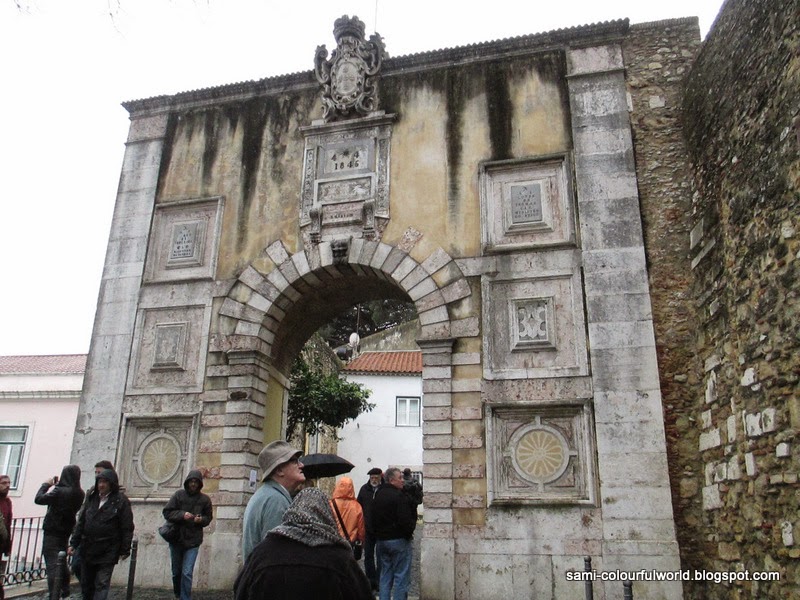
Time to leave this idyllic spot and climb the cobbled streets up to the St George's Castle.
Built in the 6th century, part of it was destroyed in the Lisbon Earthquake of 1755.
On the way up we came across this public urinol, I wonder if it's still used?

The castle is open from 9am to 6pm in winter and to 9pm in summer, tickets cost $8,50.
We opted for not going inside the castle as we still had lots to see, but I know that the views from the Castle over the city are amazing, so if you have some time go inside.

Public urinol near St George's castle


One of the staircases near the castle

Within the Castle's thick outer walls there is a small neighbourhood of Santa Cruz.

We just decided to have a short break and have a Portuguese custard tart (pastel de natal) and a hot drink at "The World needs nata" right across the entry to the Castle. 
Wow, the tarts were good, warm with a sprinkle of cinnamon, oozy when you bit into them....  Just delicious!!

The World needs Nata for a great Custard tart, near the Castle

There are also a few restaurants and bars as well as souvenir shops.
I bought some interesting souvenirs made with the traditional cork and tiles to bring to some friends in Australia.

Now we could either get the Tram 28 back to the city or choose another fun means of transport - the tuk-tuk won, and in exchange for 15 Euros, the three of us were driven downtown to Chiado. We laughed all the way...
And can you guess what the driver glued to his tuk-tuk? 
If you guesses custard tarts, you were right!!

The driver took a photo of us in the tuk-tuk. 

Tram 28 again

Thursday, 16 April 2015

Portugal - A few days in the North

We had a few days before leaving Portugal, so a trip to the Center and North of Portugal was still due.

On the highway we encountered a truck transporting sheets of cork on their way to be transformed. Portugal produces 50% of the world's cork, used in many industries that make wine bottle stoppers, shoes, flooring, bags and other household products very much in fashion nowadays.


Another interesting thing we saw on the highway was this type of sign a few kilometres before the petrol stations, advising the brand of the petrol provider, their distance and the price of petrol (which was the same for all of them).


Just before arriving we cross the River Dao, and it was wonderful to see again the beautiful scenery of the river, the houses on the slope, the lush greenery... Oh it felt good to return!


First stop, the village of Carregal do Sal, where we lived before we emigrated to Australia, situated in the District of Viseu, about 40 km south of the city of Viseu and 60km north east of Coimbra.


                                            The main church (photo from net)

We loved meeting up with old friends and some of the family, and were greeted warmly by people who hadn't seen us for a few years.

I found quite a few changes, some good, some not so good - I saw very few people on the streets and the lack of young people was worrisome, many seem to have either emigrated or moved to bigger cities, looking for work.

We arrived at lunchtime and headed straight to Cafe Central,  a small family restaurant, where we ate the Brazilian Feijoada (Black Bean and Meat Stew) that is only served by them on Wednesdays or Sundays. It was on our wish list and it was cheap and Delicious!!

Brazilian Black Bean Stew (photo from  the net)


We had other meals at various other restaurants in Carregal do Sal, one that stands out is Quinta do Cabrizfor a gourmet experience with great wines which they make on the premises and also export, as well as their own olive oil. A bit pricier, but the service is 5 star!

We couldn't leave without buying cheese from Serra da Estrela,  (highest mountain in Portugal, not far from this area) to take to Lisbon. The cheese is made of made of sheep's milk, and although the original cheese is from the mountain, you can also find a cheese factory in Carregal do Sal - Flor da Beira-  and they won a prize for best cheese in 2014.

We should have bought cheese to bring to Australia, as it was utterly delicious, still runny in the middle, just wonderful to spread. When the cheese is cured you can easily slice it. 

Image result for queijo serra da estrela
Serra da Estrela cheese (photo from net)


The three days were over too quickly and we headed further north to Braga.
On the way we found a farmer selling his fruit and vegetables by the side of the road and we stopped to buy 2 boxes of the biggest strawberries I had ever seen.

Saturday, 11 April 2015

Portugal - Sintra II

Following from my previous post, by the time we found parking and walked to the gates of the Pena National Palace, some of us were feeling a bit grumpy already, plus the queue to buy tickets was huge...
So by unanimous decision we decided to give the visit to the Palace a miss and go and have lunch instead.

I had visited the Palace many years ago, but I wasn't a blogger then and didn't always take photos of everything like I do now, so sadly I can't show much...

But of course, if you ever go to Sintra, take the time to visit the interior of the Palace and the beautiful gardens.
One of the Pena Palace towers


Traditional blue tiles
Sintra is also home to various other Palaces which you can visit -  
Palacio da Vila (Sintra National Palace or Town Palace) right in the village centre, as well as Castelo dos Mouros (Castle of the Moors) atop the hill near the Pena Palace.

Palacio da Vila - Sintra National Palace


Castelo dos Mouros - Moor Castle atop the hill

Moor Castle from a scenic lookout


Views from  a Scenic lookout in one of Sintra's streets
There are always "live statues" performing in this area from where you climb to the top of the village, and of course they rely on the public's donations. This one was quite entertaining.

My husband having fun with the live statue

After lunch we walked around the old center, bought a few souvenirs and enjoyed a "Ginja" (cherry liqueur) served in a chocolate cup. Delicious!


We climbed to the top of the village through the narrow cobbled streets and came across the Lord Byron Pub.  In 1809 he declared "We are inside one of the most beautiful places on earth" (Sintra, then written as Cintra).


The cobbled lanes with restaurants and souvenir shops

A blue tiled building in Sintra
Sintra with the Moors Castle at the top

On the way to the parking we went past Fonte Mourisca (Moorish Fountain) an Arab inspired fountain covered in colourful tiles.

This colourful statue we also on the way, right next to a Sunday crafts market that is held on the second Sunday of every month.  I bought cork bracelets and necklaces, that are now quite fashionable in Portugal, and they were quite cheap as the ladies were packing up and wanted to get rid of their stuff.


In the parking lot, this statue by Pedro Anjos Teixeira (1908-1997) from 1969, called "The persecuted" stands near the small house where he resided, now a museum of his and his Dad's sculptures.

Hope you enjoyed the tour around Sintra and this post has 

whet your appetite for a visit in the near future!

Our French and Dutch visitors certainly enjoyed their day!