COLOURFULWORLD

Sunday, 26 May 2013

Salvation Army Red Shield Appeal 2013

We have our landline phone number registered with the "Do not call register" to avoid the dozens of calls we were getting from pesky telemarketers (sorry, if you are one, I know you are doing a job, but I'm not a fan). However the register allows calls from Charities and Polls.

So, I still get a lot of calls asking for donations, etc, and of course I do give to some, but I just can't support all the callers.
Recently I was contacted to participate in a neighbourhood door to door collection for the Salvation Army - "The Red Shield Neighbourhood Appeal", to be held from 19th May to the 1st June.


At first I tried to get out of it, with the excuse I was going to Adelaide for 1 week during these dates (which was true), but the lady convinced me that it was a good cause, and I only had to give 1 hour or so of my time, by going door to door in one particular street in 
my neighbourhood, in fact the street parallel to mine.

So this Sunday, 26th May, I set off with my name tag, "sorry I missed you" envelopes, and receipt book. It was a bit daunting knocking on stranger's doors, but I had to tell myself it was for a good cause.
This year the Salvation Army is hoping to raise over 10,2 million dlrs. with this collection that will help out 1 million underprivileged Australians.

Well, I'm a bit disappointed with my collection - out of 25 houses in the street, only 5 people donated (total of $18,20), 3 others declined to donate, 2 said they had donated at the Salvation army booth at Shopping centre on Saturday, one had a "Do not enter -dog", 4 houses had walled and gated front gardens, and the others weren't home, so I left a "Sorry I missed you envelope" so they are able to send a direct donation if they wish.

But anyway, you have to remember that all the donations put together will eventually amount to that $10,2 million they expect...
  
The Salvation Army or "Salvos" in Australia also have "thrift stores/op-shops", where anyone can buy second hand clothing, bric a brac, books, furniture, etc. and at the same time help those in need.

Image result for salvos boutiques
Some of the Op shops can appear like normal boutiques (taken from net - Brisbane Salvos)
And still on the donations theme, on Saturday 25th, at a friend's invitation, I went to a Garden Tea Party/Fashion Parade to raise funds for World Vision. The gathering was at the huge grounds of a beautiful house in the Hills suburb of Kelmscott, and the donation fee was $10.


We had to take a chair, but there were plenty of tables draped in pink tablecloths. We sat down, then helped ourselves to beautiful finger food in a well laden and beautifully decorated table, and filled our cups with either tea or coffee.
The well decorated table and lovely finger food
A very different "bunch of flowers" made with paper serviettes


Maureen and another fund raiser


Then Maureen, the lady that is going to volunteer in Peru with World Vision, gave us a talk about the projects our contribution would be funding.
After the talk, we were treated to a Fashion parade, with 4 "normal models" wearing a vast array of pretty clothes. After the parade you were free to mingle and get to know the other participants, look and touch the fashion parade clothes and buy them if you wished.
We came home happy in the knowledge that we had done a good deed and had a wonderful afternoon in beautiful surroundings.

One of the models of the fashion parade
The models take a last bow
Hope you had a lovely weekend and if you live in Australia, hope you also managed to contribute to the Salvos Red shield appeal. Be generous!!

Some information about the work of the Salvation Army:
In a typical week, The Salvation Army provides approximately:
  100,000 meals and 8,000 food vouchers for the hungry
  2,000 beds for the homeless
  1,000 people with assistance in finding employment
  Refuge for 500 victims of abuse
  Assistance to 500 people with drug, alcohol and gambling problems
  Offering assistance to thousands of people with counselling
  3,000 people with aged care services                                                                                                  Family tracing services to aid in locating missing family members

Tuesday, 21 May 2013

A - Z of Australia - R is for Rubbish Removal

In some of the countries I have lived in, rubbish collection was done either weekly (in Braunschweig, Germany) or daily (in Johannesburg, South Africa), the latter involving a lot of council workers picking up bags from the pavement and throwing them into a truck driving ahead of them.

In Australia rubbish collection is a one-man show! Or one man and his truck, more precisely.

Every suburb has a designated collection day, but in my suburb, I put out my bin on the verge on Monday, and early Tuesday morning the truck comes, stops next to the bin, grabs it with some "claws" and drops the rubbish into the container, then puts the bin back on the verge. After collection you just bring the bins into your property.

In our council and in most of the cities I know, there are two bins -in Perth, one is a bin with a green lid for normal household rubbish, lawn clippings and small prunings and a yellow lidded bin for stuff that is recyclable - paper, glass, tins and cans, plastic (even plastic bags), although these recyclables should not be put in plastic bags. 
The yellow and green lidded bins awaiting collection

The truck picking up the bins


The green bin (normal rubbish) is collected once a week and the yellow bin (recycle) is collected fortnightly, on the same day as the green bin, with two different trucks doing the job.

Construction or building materials, soil or hazardous materials are not allowed in the bins and must be discarded at the  local Recycling facility (information about their location available from your Council or their website).

The council has a list of items that can be recycled and how to dispose of items that they do not collect, like construction material, etc.


Picking a recycling bin with the "claws"

Twice a year (in my council), we have a Green verge collection and a Hard Waste verge collection.
I find this service, which is of course provided through the property rates you pay your council, is to me one of the best services the council provides.

The hard waste comprises old furniture, white goods, televisions (these were out en masse lately due to a change from analogue to digital tv in recent months), general household junk.
Again, no construction material, motor vehicle parts or flammable liquids are allowed.

The council provides a map, (online as well) with zone maps and date schedule for each suburb within the council. You are allowed to put out the waste two weeks before collection begins.


They claim to remove up to 1 standard trailer load of hard waste from each property, but I have seen some houses with so much rubbish, they must have certainly thrown out the whole house!!

* When people start putting their stuff out on the verge, you can see a few people driving by with their small trucks, and they stop to examine the piles of stuff and sometimes pick a few things to take with them. I once saw an orange lounge suite being taken away, and then a couple of days later I went to the "flea market" and there it was for sale. "Money for nothing"!
Some things are actually quite good, and can just be renovated with a lick of paint or varnish.
A few years ago I saw 2 pretty round cane chairs a couple of houses from mine. They had nothing wrong with them apart from lack of varnish. So at night I went to get them, one by one, and after sanding and varnishing them, bought foam to make the pillows and they are still in use in my backyard!

Household rubbish, furniture awaiting collection
With the Green Waste verge collection, only tree prunings no longer than 1.5 metres, leaves, etc, but nothing inside bags. In this instance, two trailer loads will be removed from each property. 
These prunings are used to make mulch, which the council then sells back to us to put on our gardens in summer.
Green verge collection - a tractor picks tree trunks to put into the rubbish truck


Of course the cost of these services are built in the house and land taxes you pay your local Council, but I think we are being provided a very good and efficient service, and the cities are left clean and tidy.
How is the Rubbish collection done in your country?


Sunday, 5 May 2013

Port Lincoln


On another one of my visits to Adelaide, we took advantage of the long weekend to visit 
Port Lincoln on the southern extremity of the the Eyre Peninsula, a beautiful city overlooking Boston Bay.

This harbour town, discovered by captain Matthew Flinders in 1802, was named after the town he came from, Lincoln in the UK. 

In a straight line, it is located 280km from Adelaide, but by road, you have to either drive 310km north to Port Augusta, then travel south another 340km to Port Lincoln, or travel from Adelaide to Wallaroo, also about 300km north, take the ferry to Lucky Bay across the Spencer Gulf, a trip lasting just over 2 hours, and then travel south 175km to Port Lincoln.

We took the ferry option as it would also be a time to relax instead of being behind the wheel. Book ahead as there are only 2 trips a day and the ferry can get booked out, as it only carries 80 cars or equivalent . It's quite comfortable with tables and chairs, lounge chairs where you can watch tv, a movie corner, play area for kids and a coffee shop.

                                                           Leaving Wallaroo by ferry


Enjoying the fresh air on the deck
Port Lincoln, known as the "seafood capital of Australia", is also home to Australia's largest fishing fleet.
There is a huge aquaculture industry of bluefin tuna for the Japanese market, as well as oysters, mussels, kingfish, yellowfish and lobsters.
I had tasted oysters many years ago and found them to be quite rubbery, but here I tasted Kilpatrick oysters (with bacon and tomato), and I became a fan. I also ate a lovely tuna steak, something that I had last eaten on my trip to the Azores.

Port Lincoln missed becoming the state capital of South Australia due to the lack of fresh water supply, which is now supplied via a pipeline from the Murray River.
It has a population of over 14,000 people, and has the highest number of millionaires per 
capita. Fishing pays well it seems!!


A fishing boat goes out to sea

A small crane on a boat loads frozen sardines from a truck to feed the Tuna at the aqualculture

Hundreds of fishing boats at the marina
If you are a keen fisherman this is the place for you. There are organized shark cage diving tours, swimming with Tuna tours, or high sea fishing tours.

Apart from the huge fish processing industry, and tuna farming for the Japanese market,
there are grain handling facilities all over the Eyre Peninsula (we saw loads of huge tanks 
all along the highway near all the little towns).


Grain tanks at Arno Bay
We stayed at the Marina Hotel apartments - a very nice 1 bedroomed apartment with a small lounge and kitchenette with a microwave and fridge, but no stove.


The Marina apartments where we stayed
The weather wasn't the best, with a bit of rain and some sunny moments in between, as you can see from the next two photos, taken at the Marina canals.


 Makybe Diva, the famous horse that won the Melbourne cup 3 times (2003, 2004 and 2005) and the highest money owner in Australian history (over 14 million dlrs) has a life size bronze statue on the foreshore near the jetty. His owner, who own a fishing business hails from Port Lincoln.


We drove to Coffin Bay, named after Isaac Coffin, a naval officer friends with Matthew Flinders, another fisherman's paradise, and known as the Oyster farming capital of Australia.
This small town is about 45km west of Port Lincoln, only has about 600 residents which swell to a about 2000 people during holiday season. It has a huge national park (entry fee applies), which we didn't visit for lack of time and rainy weather.

View of Coffin Bay taken from a lookout a lookout
Coffin Bay jetty and kids park
Pelicans catching rain with their open beaks 
 Back in Port Lincoln, we stopped at a supermarket to buy some fruit and I noticed this interesting building across the road - a former church turned into a shopping centre.

A church turned into a shopping centre
A memorial to Fishermen that died at sea, at the Marina
A rainbow in the dark sky, at the Marina
A red sunset with the grain facilities at Port Lincoln

On the return trip to Adelaide we again stopped at various little port towns along the way just for a quick rest, a warming up coffee or to take a beautiful photo. This next photo was taken just before arriving in Lucky Bay, a tree full of shoes! I wonder how this got started?

Shoe tree near Lucky Bay

At Lucky Bay with the ferry docking
 A wonderful short break indeed and another beautiful area of South Australia.

Tuesday, 23 April 2013

Postcrossing - an interesting hobby

I came across Postcrossing about a month ago, when one of my friends from Portugal recommended I join this site if I liked postcards.
I do have a big collection of postcards, that I keep in a box, that I began collecting when I started travelling at the age of 18.


My postcard box
My first postcards were bought in Brasil, my first port of call on a round the world trip to 
5 different countries in 3 continents. Since then, I bought a couple of postcards in every country I visited.

So I joined Postcrossing, filled in my details, and requested 5 addresses to send postcards to.
You get given a code with letters and numbers to be written in each postcard, which identifies the country it comes from and helps identify the sender when the receiver receives it.
I wrote a little note describing the photo in each postcard - all of them from Perth - and posted them. The addresses were all in Europe.


One of the cards I sent
I got notified by email when the cards reached their destination, and to date only 3 have reached their home, having taken from 14 to 28 days to travel.
I wonder if some have taken the sea route instead of crossing the seas by plane? The post shouldn't take that long from Australia to Europe, should it?

I was quite thrilled when one of the addresses I was given was in Braunschweig, Germany - a town where we lived for almost 6 years, and where my kids were born, over 25 years ago. What a coincidence!

Today I received my first two postcards - one from China and one from the United States.
When you receive a postcard you log in, and register the code on the postcard and scan a copy of it if possible, so it's visible to anyone visiting the site. At the moment over 402 thousand people from  216 countries participate in this project with over 16 million postcards exchanged.
  
My first postcards from Postcrossing - a cat from China, and one from San Antonio in the USA
On my Postcrossing profile I wrote that I also collect stamps, and one of the ladies I exchanged a postcard with also collects stamps, so we are now exchanging stamps between Australia and the Netherlands.
Communication is done via the Postcrossing site, so no addresses need to be exchanged unless you decide to do direct swapping or other exchanges, like the stamps in my case.

So if you already collect postcards, or would like a new hobby, why not give Postcrossing a go?
Who knows maybe one day you might be sending me a postcard from your city.

And in this day and age when penmanship is a dying art and most people communicate verbally, by sms or email, it's refreshing to be able to write a few words to someone and actually put a stamp on a postcard or envelope...

Thursday, 18 April 2013

Coral Bay to Perth - Homebound 2

Day 9 - Geraldton to Perth - 430 kms, 9 hours with stops 
- Part 7    
(Total travelled - 2844km in 9 days)

After a great night's sleep, we got dressed, had breakfast, and packed our stuff into the car.
We filled up the tank, at 1,459$/litre, and at 10A.M., with the thermometer at 24.C, we set off on our way to Cervantes to go and visit the Pinnacles.
Leaving Geraldton - the lighthouse
We took the Brand Highway (North West Coastal Highway until Geraldton) that runs close to the Indian Ocean so we would be able to have some scenic stops on our way.
The countryside is greener, prettier and with some hills and dazzling white dunes, unlike the barren northern area of WA.

White dunes and green bushes next to the road
Port Denison, view of harbour
Our first quick stop was Dongara/Port Denison, about 70kms away from Geraldton. 
Shortly after leaving Port Denision the road forks and we took the Indian Ocean Drive that runs parallel to the sea. Next stop was another tiny sea side town - Leeman - 150km from Geraldton, where I climbed the Ti-Tree Point for some wonderful 360 degree views of sea and surrounding area.


The steps to the lookout at the top 
One of the wonderful views over Leeman beach and pier
Another 45kms and we arrive in Jurien Bay in time for lunch. We take a few wrong turns until we find the road leading to the town's pier and a cafe near the water.
We ordered and sat down to a meal of fish and chips for 2 and hamburgers for the other 2, 
all with fries of course! I don't think any of the restaurants where we ate along the way ever offered food without a side of chips, why not rice?

The long jetty at Jurien Bay
Jurien Bay beach
The kids play area by the beach at Jurien Bay
Jurien Bay, was first known to Europeans, when in 1801 a French expedition sailed along the WA coast, and named the spot after Charles Marie Jurien a French Naval officer.

The multi-million dollar Crayfish or Western Rock Lobster industry, has influenced the growth of Jurien Bay, with the building of jetties, fish processing factories, even an airstrip...
The majority of the catch is sold to Japan and the United States for big bucks!
This prosperity is patent in the big mansions and fleet of big fishing ships and yachts.

Crayfish season starts in November and every year the "Blessing of the Fleet" festival is held to commemorate the occasion.

Jurien Bay is also becoming popular for Perth residents as a summer destination, due to the proximity to Perth (220km), the great beaches and good fishing. 
You can also snorkel and meet sea lions and dolphins within the Jurien Bay Marine Park sanctuary.

After lunch we drove 26kms south to Cervantes. Just 1km before the town, we turned to the Hansen Bay Lookout road, to visit Lake Thetis, one of the few places in the world where you can see "stromatolites". 

We had decided not to stop at the Shark Bay Stromatolites, when we travelled from Denham to Coral Bay, so we had to stop and check these.  

Around 4800 years ago the sea levels dropped and the salty lake became isolated, with coastal dunes forming around it.  Some fish and birds have adapted to the salinity and can be seen in the water.
The Stromatolites look very much like rocks, but are living fossils, built up by layers of bacteria and calcium that thrive in the salty lake.

Lake Thetis has a circumference of 1,2km and has a boardwalk path all round, so it makes for a enjoyable walk.


Stromatolites in Lake Thetis, Cervantes
Just like Jurien Bay, Cervantes is also a fishing industry town, as well as a tourist spot due to the nearby Pinnacles. 
Named after a ship that was wrecked nearby, named "Miguel de Cervantes" after the author of "Don Quixote". Strangely enough, a lot of this small town's streets have Spanish names -  Seville street, Barcelona Drive, Cordoba Way, Valencia Road...

We drove into Cervantes, once again hoping to buy some frozen lobsters (we had been asking in every fishing town since Geraldton) and finally found a processing factory where we bought 4 frozen lobsters that went into our cooler box. Hurray!!

The attractions in Cervantes are the wildflowers in Spring, good fishing and beaches, four wheel driving through the sand dunes from Cervantes to Lancelin, buy some rock lobster at the Ocean Rock Factory, enjoy a lobster at lunch or dinner at one of the restaurants (season runs from November to June), visit Lake Thetis, visit the Emu Downs wind farm and climb the Molah Hill lookout, situated in-between Jurien Bay and Cervantes for views over both towns - quite a lot to do in such a small town!

After our purchase we drove another 18kms to the Pinnacles desert, where we paid $11 per vehicle  for the entry into the Nambung National park. After visiting the modern Discovery centre to learn about the fauna, flora and history of these strange rocky formations we got in the car again, to travel the 4km road loop around these majestic and strange rock formations. The driving trail is not suited to Caravans and trailers.
If you enjoy walking, you can leave the car in the car park and walk the 1,2km trail.


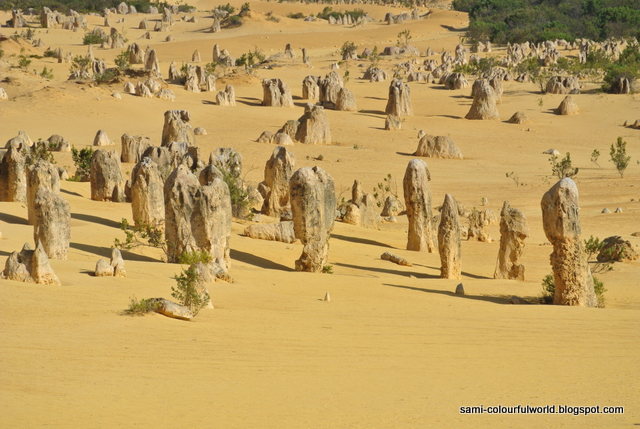
The Pinnacles desert with an area of about 190 hectares, contains thousands of limestone pillars, some up to 5mts high, rising from the ochre sands. Their formation mechanism is controversial and there are 3 different versions. Also not know is how long ago these were formed, with 80,000 years ago, being given as a guide.
They are best viewed at dawn or sunset when the shadows create patterns over the desert sands and the play of light brings their different colours and features.
The area attracts about 250,000 visitors a year, with the months from August to October being the most popular due to the wildflower season at the Nambung National park.
There are some mainly nocturnal animals in the park, but you might encounter Emus and Kangaroos during daytime. 


kangaroos eating some greenery next to some Pinnacles


The car trail in between pinnacles


Could this one be the highest pinnacle at 5 metres?  Daughter, hubby and me.
More dunes in the distance
One of the fancy rest stops along the road from the Pinnacles to Perth
View from a lookout along the way


From this map you can see our route along the coast from Perth to Geraldton, Kalbarri, Denham/Monkey Mia, Carnarvon, Coral Bay and the return from Coral Bay to Geraldton, and via the Pinnacles to Perth, travelling 2,844km in 9 days!

I would certainly love to return to Coral Bay, and to visit Exmouth, where we didn't go, but I don't think I would do it again by car. It's just too far, and having seen what we wanted to see along the way, I think next time I would rather just fly from Perth to Exmouth, hire a car and then travel around the area. 

And in case you are wondering what happened to the lobsters we bought in Cervantes, here they are! My wonderful husband cooked Lobster Thermidor for our farewell dinner with our daughter and son in law, the night before they flew back to France. We even had home made chips, yes chips again...although I think these were healthier than the ones we ate in the restaurants along our road trip. A wonderful meal to be remembered.

Defrosting the lobsters
Lobster Thermidor, in the oven
Lobster with chips

Hope you have enjoyed reading about our road trip and that my account and photos have whet your appetite to embark on a road trip in your country, or maybe even in Australia.