COLOURFULWORLD

Friday, 27 March 2015

Amsterdam - Science, Animals and a taste of Brasil


A wet, foggy and miserable day, but we decided we would take our bikes into town and were joined by our daughter who had taken the day off work.

First stop the Zoo - Artis - surrounded by canals on all sides, it's located almost in the city centre in the Plantage district. 
The entry fee of 19,95 Euros is quite steep, but it was free for holders of the City card. You can buy a map of the zoo for a few extra euro.

I'm not a great fan of zoos, as I feel sorry for some of the bigger animals who don't seem to have enough space to roam around. Here for example I thought the elephants, giraffes and even the ostriches displayed behaviours of caged animals and their enclosures were too small and bare. They had a lot of smaller type monkeys which I had never seen.
Mountain goats
The cheeky monkeys eat fruit upside-down
The elephant enclosure
The huge Pelicans
The camels
The huge turtles


The lion enclosure


This coin operated kids cart was quite interesting


There was a tropical enclosure, with butterflies that was quite amazing. 
The butterflies flitted around quite quickly and it was quite difficult to capture them in a picture. 
There were other pavilions with an Aquarium, Bird house, Aviary, an even a Planetarium. 
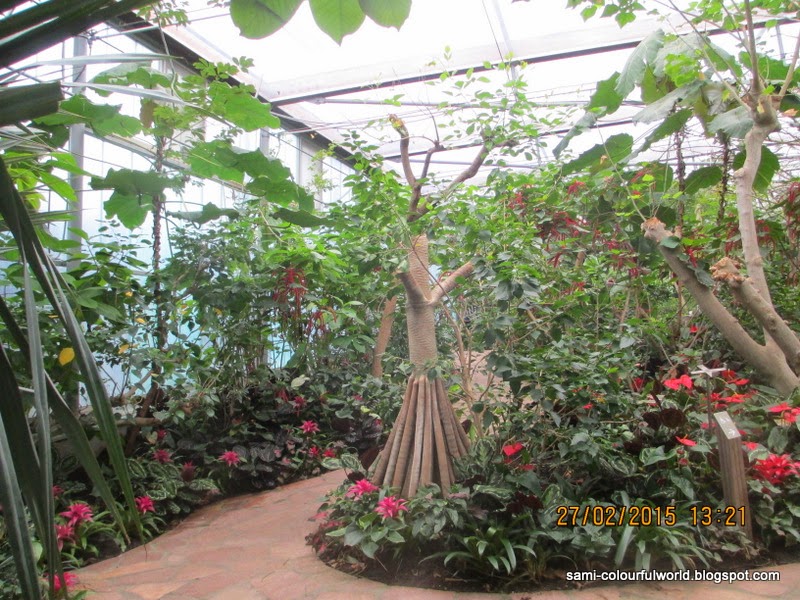

The tropical enclosure and butterfly garden
Fruit for the butterflies


Next to the Zoo, you can also visit - Micropia - a museum of microbes, which opened in October last year, but by the time we finished with the zoo, we were hungry and decided to rather go and have lunch across the road.

On our bikes again, we rode to the Science Center - Nemo - housed in a futuristic building in the harbour district of Oosterdok, this science and technology interactive museum over 5 levels will keep kids occupied for a few hours! 
There is a roof terrace from where you can get a great view over the city, but it was closed as a restaurant is being built up there.


Nemo Science Museum


Entry costs 15 euros, once again free for City card holders, and is open from 10am to 5,30pm, and closed on Mondays except during school holidays and from May to August.

Being school holidays it was packed to the roof with kids and their parents, but we still enjoyed trying out some of the experiments.  


I was amazed at the Cloakroom which every museum seems to have, but this one was huge and had at least 3 or 4 people working there! 


From this cloak room you can see the number of visitors....
Next was an in and out visit to the National Maritime Museum, just a short ride from Nemo, as they were about to close, and I just wanted to photograph the replica of the "Amsterdam", the Dutch East India Company vessel which sank in a storm in 1749 off the English channel, on the way to Batavia (now Indonesia).  Entry is also 15 euros, free for City Card holders.
This ship is also quite popular with kids.
The Maritime museum seen from Nemo Science Museum
The entrance hall of the Maritime Museum with the glass ceiling

Nemo Science Museum seen from the Maritime Museum


On the way home we went past the shop from where we hired our bicycles to hand them in, but the shop was closed on Thursdays, so we had to return the next morning.

At night we went by tram to the De Pijp district, just south of the city, to a Brazilian restaurant near the Albert Cuyp street market which we planned to visit the following day.

Samba Kitchen, was modern but homely. They had a rodizio (all you can eat meat buffet), salads, etc. for 27,50 euros which included a Caipirinha to start with, but not the wines.

The caipirinhas were prepared right in front of us which made for an interesting display, the staff were friendly and when we told them we were Portuguese they came over and chatted to us. (Forgot to take photos of the whole procedure and the meats...)

Image result for caipirinha de kiwi e morango
Kiwi and Strawberry Caipirinha (photo from net)

Here you can see a Youtube video about Samba restaurant. If you a a meat fan this is the ideal restaurant, for me it's a bit of a waste as I'm not such a great meat eater...


Thursday, 26 February 2015

Wednesday, 25 March 2015

Amsterdam - city card and Museums

On the morning of the 25th February we took the tram into Central Station and tagged on with the 48 hour Iamsterdam city card we bought the day before. The time starts counting the minute you tag on for your first transport ride, and for the Museum side once you tag on your first entry.

We walked to Kalverstraat 92, (remember the fancy pedestrian shopping street I mentioned here?) and almost hidden from the street is the Amsterdam Museum, formerly a 17th century Orphanage that operated for 400 years. You can find out more about this era inside.


Here you can discover the history of Amsterdam from it's beginning till today's modern city - Amsterdam DNA they call it. 

A lot of interactive displays, art and old artifacts. At the reception counter you are given a booklet in your language of choice with a bar-code on the cover, and to hear the commentary on the displays, just tag the bar-code on the screen of the various columns scattered around the museum and put the earphones to your ear to follow the commentary.

Entry costs 12 Euros, but of course it's free with the city card we had, it's open from 10am to 5pm and I highly recommend a visit. It wasn't crowded either which made for a pleasant visit.  There is a pleasant Cafe in the courtyard.

Entry to the Amsterdam Museum at 92 Kalverstraat


The Orphanage area

Inner courtyard at the Amsterdam Museum
Statue of Anne Frank, a Jewish girl who went into hiding and wrote a diary about her experiences


Most Amsterdam buildings are built under sea level...


The museum also houses a portrait gallery on the ground floor, called the Schuttersgalerij (Civil Guards Gallery) with artworks from old masters to modern artists, wooden statues of David and Goliath, and best of all it's a free area. (It's also a passage way to another street)


From the top floor of the Museum you can see the paintings in the Portrait Gallery, as well as a gigantic statue of Goliath and two smaller statues of David and and a shield bearer. The wooden statues created in 17th century were previously attractions in an Amusement park. They do look impressive here!

Modern painting depicting various personalities from Dutch history
One of the old Masters portrait


David and Goliath


In this gallery there is a 40 metre long carpet runner designed by Barbara Broekman showcasing the 179 different nationalities currently living in Amsterdam.
To showcase this cultural diversity the artist stared studying the textiles of the various countries and she then chose a characteristic detail from each country from it's carpets, clothing, tablecloths, etc, and weaved this into different squares.

The Portuguese lace in the white block
The top middle square depicts typical Aboriginal paintings (Australia)


Lunch over we took Tram nr. 9 and got off at Rembrandt Plein, one of the busiest squares in the city.  In the middle is a statue of Rembrandt sculpted in 1852, looking down on the 3D version of his "Nightwatch" painting which hangs in the Rijksmuseum. 

From here a short walk to to the Willet-Holhuysen Museum, at Heerengracht 605. 
Heerengracht is the posh street of Amsterdam with the palatial homes that can be seen from the canal on the boat tours.


The Willet- Holhuysen museum opens from 10am to 5pm, entry costs 8,50 Euros (free for city card).

This family residence built in 1685-1690, was last occupied by wealthy art collectors - Abraham and Louise Willet-Holthuysen. Being childless, they donated the house and it's contents to the city of Amsterdam on the condition it would be made into a Museum, which then opened to the public in 1895. This splendid house on 4 floors showcases how the well traveled couple lived their glamorous and opulent lifestyle among their extensive art collection. Behind the house is a long 18th century style French garden.


Everything from the high ceilings (maybe 5 to 6metres high) to the sweeping staircase shows the class of these residences.


The impressive facade of the Willet-Holthuysen House on Heerengracht.


Main entry on 1st floor where you can see the ceiling height

The very modern kitchen in the basement, used by the servants


The Women's Salon


The Study/small collection room, overlooking the garden


The garden laid out in 18th century French style


We hopped on the Nr 9 tram again to go to the Rembrandt House Museum at Jodenbreestraat 4, near the National Opera and Ballet. The Museum is open from 1am to 6pm and entry fee is 12,50euro (free with city card).
Rembrandt lived here between 1639 and 1658 and the house interiors have been restored to their original state. Most of his paintings and etchings are housed here, as well as art works from his many art students.

                                                                   
The kitchen with a fireplace, where cooking and eating took place. The box bed is where the maid slept. You might think it's too small, but in those times people slept almost sitting up.


This north facing room, was the largest in the house and is where Rembrandt painted and kept his casts. In the corner was a box bed where he slept.


A collection of his casts and other collectibles are stored in this room.
There are daily etching and paint mixing demonstrations showing how to mix the pigments like Rembrandt did.


The sun had set, getting cold again, so it was time to go home.

From today's visit I highly recommend the Amsterdam Museum as it was for sure the best museum we visited in Amsterdam and the Willet-Holthuysen House was also very interesting to get an idea how the high society, merchants and traders lived a few centuries ago.


Wednesday,25th February 2015